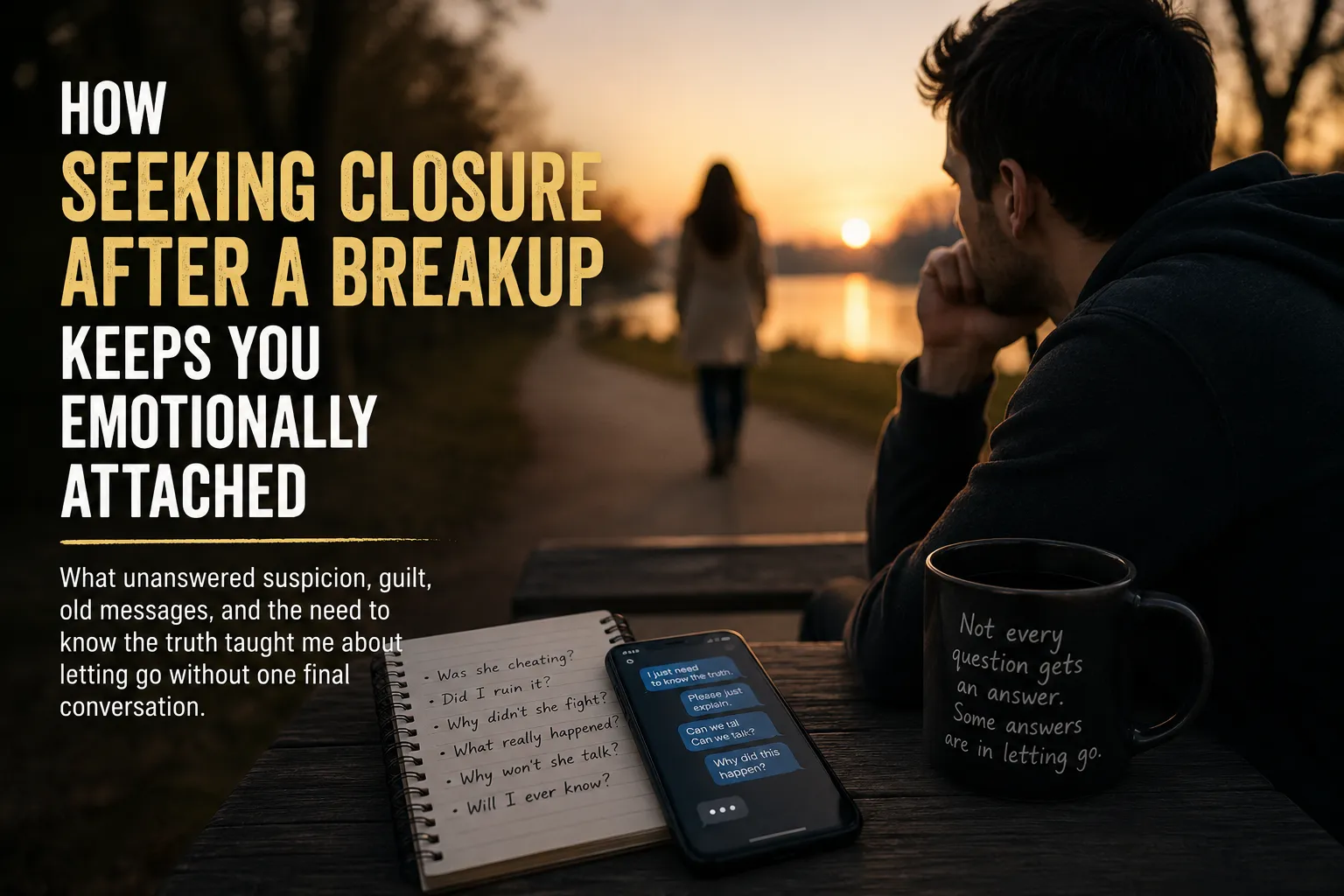
Seeking closure after a breakup can feel like a necessary part of moving on. You may want to understand why the relationship ended, know whether your suspicions were justified, hear an apology, or have one final conversation that makes the past feel complete.
Sometimes that conversation helps.
But closure can also become another form of emotional attachment when your peace depends on receiving an answer from someone who is no longer willing or able to provide it.
You keep replaying conversations.
You reread old messages.
You check social media for clues.
You imagine what you would ask if the opportunity finally came.
The relationship may have ended, but the unanswered question keeps it active inside you.
I know what that feels like.
One relationship in my past ended around a question I could never settle:
Had I recognized a real betrayal, or had my fear helped destroy something that might otherwise have survived?
Why Closure After a Breakup Can Become Another Attachment Loop
Closure is supposed to create an ending.
It can help two people name what happened, acknowledge the hurt, and understand why the relationship could not continue.
Wanting that is not wrong.
The problem begins when closure becomes a condition for healing.
You may begin believing:
I cannot move on until they tell me the truth.
I cannot heal until they apologize.
I cannot let go until they admit that I mattered.
I cannot stop questioning myself until they confirm whether I was right or wrong.
That gives your former partner continued authority over your peace.
Even without direct contact, the relationship remains emotionally open because you are still waiting for them to finish the ending.
Closure then stops being one conversation you hope to have.
It becomes a loop.
Every unanswered question creates another imagined conversation, and every imagined conversation gives the relationship another place to live.
When an Unanswered Question Keeps the Relationship Alive
The relationship I keep returning to began during a complicated period in both of our lives.
Neither of us had entered it from a perfectly clean or simple place. There were unfinished circumstances around us, but the connection still felt real.
For a time, it became one of the better relationships I had experienced.
That mattered later because the ending did not fit neatly with the good I remembered.
As the relationship became more uncertain, she remained connected to someone from her past in a way that made me uncomfortable.
I became suspicious.
I questioned what was happening when I was not there. I looked for reassurance but did not feel reassured. Eventually, concern became accusation.
The accusations placed more pressure on the relationship.
Then the relationship ended.
I never received enough information to know whether my suspicions had been correct.
That left me trapped between two painful possibilities.
If my suspicions were right, someone I trusted had betrayed me.
If they were wrong, my fear may have helped destroy something good.
For someone carrying an unanswered breakup question, that uncertainty can become more emotionally powerful than a clear ending. Certainty feels as though it would finally tell you whether to feel betrayed, guilty, angry, relieved, or regretful.
But sometimes the past refuses to give you a clean verdict.
Why Suspected Cheating Makes Closure Harder to Find
Questions about possible cheating can be especially difficult to release because they affect more than the ending.
They can make you question the entire relationship.
Was the connection real?
When did something change?
Was I being lied to?
Did I ignore warning signs?
Did my fear invent warning signs that were not there?
Could I have handled the situation differently?
You may believe that one truthful answer would settle everything.
But even an answer often creates more questions.
An admission might make you ask when it began, why it happened, or which memories were genuine.
A denial might leave you wondering whether you are still being deceived.
Proof that nothing happened might replace suspicion with guilt about how you reacted.
That is why closure does not always come from collecting more information.
Sometimes the information cannot repair what uncertainty already changed.
This is where How to Pause Before Reacting becomes part of the larger lesson. Pausing does not mean ignoring your instincts or accepting behavior that damages trust. It means creating enough space to separate what you know from what you fear before fear begins making decisions for you.
For readers facing uncertainty inside a current relationship, that distinction may protect something important.
For readers looking backward after a breakup, it may help explain why one unanswered question became so difficult to release.
How Rereading Messages Keeps You Emotionally Attached to an Ex
After relationships end, I have a tendency to revisit them through old messages.
I reread conversations.
I search for the moment when the tone changed.
I compare what was said earlier with what was said near the end.
I look for contradictions, hidden meanings, or clues that might answer something I missed the first time.
Social media can become part of the same pattern.
You may check whether your ex is with someone else, whether they appear happy, whether they posted something that seems connected to you, or whether their current life confirms the story you created about the breakup.
It can feel like research.
But emotionally, it is still contact.
You may not be speaking directly to the person, but you are repeatedly returning to their presence.
Old messages do not only contain information. They contain an earlier version of the relationship and an earlier version of you.
Reading them can briefly restore the closeness that no longer exists.
This is one reason Why You Still Grieve After Setting Boundaries in a Relationship matters. A boundary may end direct communication, but the mind can continue reopening the relationship privately.
Sometimes letting go requires more than refusing to send a new message.
It requires deciding that old messages will no longer be treated like an unsolved case.
When One Final Conversation Feels Like the Only Way to Heal
Years after that relationship ended, I still believed one honest conversation might help.
I wanted to know what had really happened.
I wanted to explain what I had feared.
I wanted to understand whether the relationship had ended because trust had already been broken or because my reaction broke it.
Part of me hoped time might make that conversation possible.
It never happened in the way I imagined.
That forced me to face something I did not want to accept:
The person who participated in your confusion may not be the person who helps you resolve it.
Your ex may remember the relationship differently.
They may not want contact.
They may not feel they owe you an explanation.
They may continue denying what you believe happened.
They may hold their own hurt and blame.
They may no longer be able to speak with you without reopening everything they are trying to leave behind.
That can feel deeply unfair.
But fairness and availability are not the same thing.
You may deserve clarity and still never receive it from the person you hoped would provide it.
How Guilt and Self-Blame Can Keep You Connected to an Ex
My desire for closure was not based only on suspicion.
There was also guilt.
During that season, something I said or did had consequences I did not fully anticipate. The details involve another person’s private life and are not mine alone to publish.
What matters here is that she believed I had caused serious harm.
I did not intend the outcome.
But intention does not automatically remove regret.
For a long time, part of me wanted a conversation that would release me from her version of the story.
I wanted her to understand that I had not acted with the purpose she assigned to me.
I wanted her to acknowledge that the situation was more complicated than one mistake.
I wanted forgiveness—or at least a more balanced understanding.
That created another form of attachment.
Sometimes we keep seeking closure because we want our former partner to remember us differently.
We want them to stop seeing us as the villain.
We want permission to stop carrying the blame.
But closure cannot always come from persuading someone else to change their interpretation of you.
You can take responsibility for your part without accepting responsibility for every choice, circumstance, and consequence surrounding it.
You can regret something without making regret your permanent connection to the person who was hurt.
You can wish you had acted differently without believing you must remain emotionally attached until they forgive you.
Why Physical Attraction Can Make an Ex Feel Irreplaceable
Another part of my attachment was the belief that the relationship might be difficult to replace.
Physical attraction mattered strongly to me, and I feared I might never experience that same level of attraction again.
That belief gave the relationship a sense of scarcity.
It was no longer only:
I lost someone I cared about.
It became:
I may never find this again.
When you believe a former partner represents a rare opportunity, the mind may assign greater value to the relationship than its full reality deserves.
You may minimize uncertainty, instability, or incompatibility because losing the person feels like losing proof that someone like them could choose you.
Attraction matters.
But attraction can also become part of the attachment loop when it makes one person feel impossible to replace.
Sometimes we are not only grieving the individual.
We are grieving what being chosen by that individual seemed to prove about us.
That is where Mistaking Intensity for Love becomes relevant. Strong attraction, emotional urgency, and fear of scarcity can make a relationship feel uniquely destined even when other parts of the connection were unstable.
Someone can be deeply attractive to you without being the only person you could ever love.
Someone can feel rare without being healthy to reopen.
Why an Answer May Not Give You the Closure You Expect
It is natural to imagine that certainty would finally make the pain easier.
Maybe it would.
But closure is not always the same as discovering the truth.
You could learn that your suspicion was correct and still grieve the betrayal.
You could learn that it was wrong and still grieve the relationship you helped lose.
You could receive an apology and still wish the damage had never happened.
You could hear that you mattered and still know the relationship cannot return.
Information can clarify the past.
It cannot always restore what the past took.
That is why the search for closure can continue long after enough information has already arrived.
At some point, the real question may no longer be:
What exactly happened?
It may be:
Why do I still need the past to become different before I allow myself to move forward?
What to Do When Your Ex Will Never Give You Closure
Creating your own closure does not require pretending you know what you do not know.
It begins by separating certainty from acceptance.
You may not know whether every suspicion was correct.
You may not know what your ex was thinking.
You may not know whether one calmer conversation could have changed the ending.
You may not know which person carries more responsibility.
But you can still know enough.
You can know that trust had become damaged.
You can know that the relationship ended.
You can know that repeated attempts to solve it have not produced peace.
You can know that checking messages and profiles keeps reopening the attachment.
You can know that one more conversation may create more questions instead of fewer.
You can know that your future does not have to wait until the past becomes completely understandable.
Closure may begin when you stop treating uncertainty like an assignment you are required to finish.
How to Create Closure Without Pretending the Relationship Never Mattered
Creating closure is not the same as erasing the relationship.
It does not require declaring that every good memory was false.
It does not require denying that you loved the person.
It does not require pretending you would not change parts of the story if you could.
It requires changing how much access the unfinished story still receives.
That may mean no longer rereading the same messages.
It may mean refusing to search social media for answers.
It may mean writing down what you know and what you may never know.
It may mean admitting what you regret without repeatedly putting yourself on trial.
It may mean accepting that your former partner’s interpretation of you is outside your control.
It may mean recognizing that a relationship can have contained real love while still becoming something you should not reopen.
This is part of How to Set Boundaries in Love Without Feeling Guilty. Sometimes the boundary is not only between you and another person.
Sometimes it is between your present life and the questions that keep pulling you backward.
A Scripture I’m Carrying
“Brethren, I count not myself to have apprehended: but this one thing I do, forgetting those things which are behind, and reaching forth unto those things which are before,
I press toward the mark for the prize of the high calling of God in Christ Jesus.”
— Philippians 3:13–14
I do not read “forgetting those things which are behind” as an instruction to erase the past or pretend the relationship never mattered.
Some memories remain.
Some questions remain.
Some regrets require honesty rather than denial.
But the past cannot remain the only direction my attention knows how to face.
Moving forward does not mean I finally understand everything.
It means what I may never understand no longer has unlimited authority over where I go next.
What This Chapter Taught Me About Closure After a Breakup
Closure is not always receiving the confession, apology, explanation, or final conversation you hoped for.
Sometimes closure is accepting that the person connected to the wound may not be able to help you heal it.
It is separating what you know from what you continue trying to prove.
It is taking responsibility for your part without carrying every part.
It is recognizing when rereading messages is no longer helping you understand and has started helping you remain attached.
It is admitting that attraction, guilt, regret, and unanswered suspicion can all make one relationship feel more unfinished than it truly is.
I may never know whether every fear I carried was justified.
I may never know whether the relationship could have ended differently.
But healing does not require a final verdict.
The relationship ended.
The question remained.
And I am learning that I am still allowed to end my participation in the question.
Continue the Story
- How to Stay No Contact When You Still Miss Someone
How distance protects healing when one conversation could restart hope, attachment, and pain. - Why You Still Grieve After Setting Boundaries in a Relationship
Why making the right boundary does not immediately remove love, loss, or emotional attachment. - How Hope Returns After Heartbreak When You Stop Forcing It
How openness to the future can return without denying what the relationship meant.
Move Through This Book