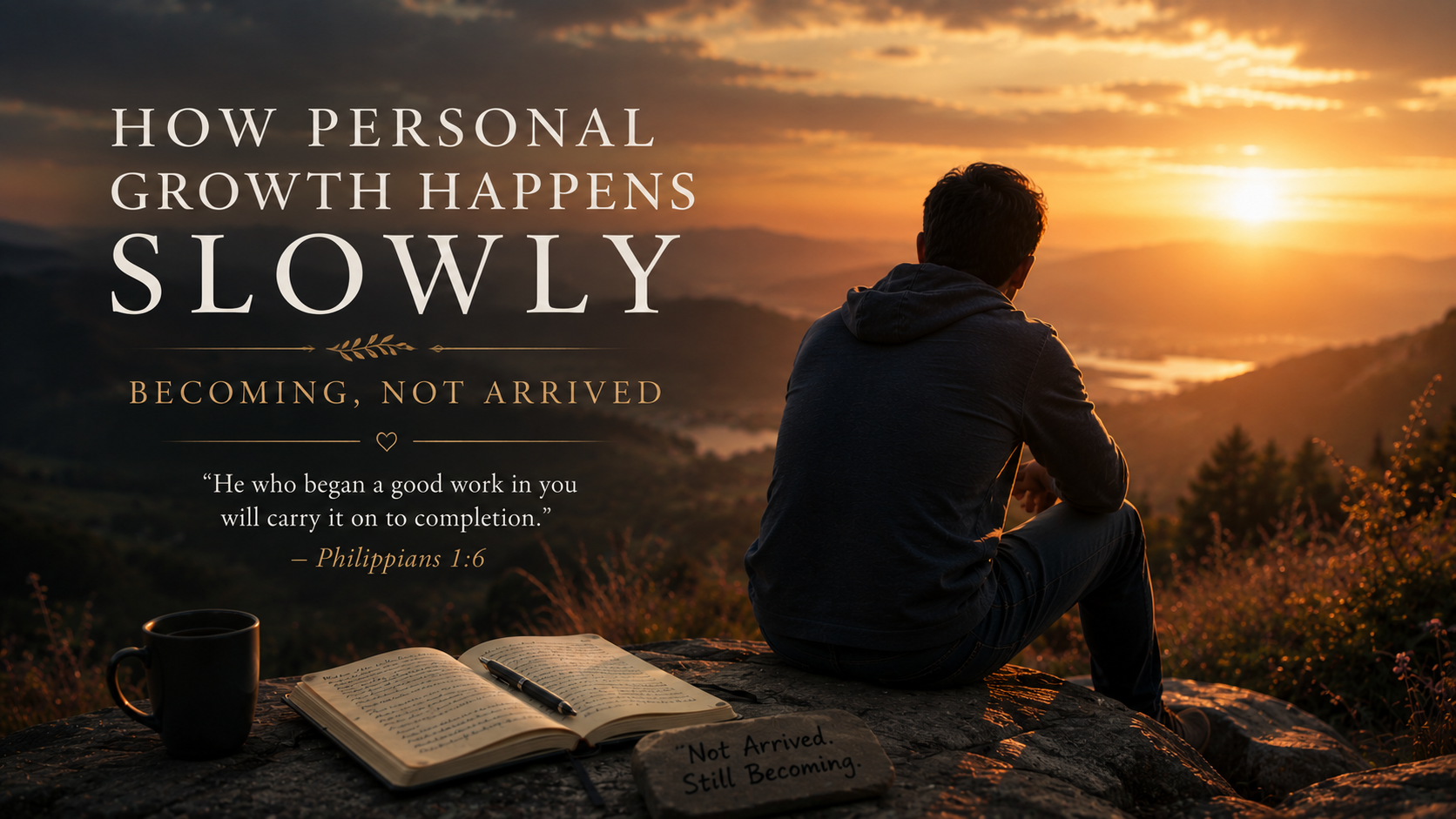
Personal growth can feel slow when healing is unfinished, progress is quiet, and you still do not feel like the person you are trying to become. If you are in the middle of change but not yet where you hoped to be, this chapter is about learning to honor the process instead of rushing the outcome.
Becoming does not require you to be finished before God can still be working.
That has taken me a long time to understand.
For years, I thought growth would feel more obvious. I thought healing would announce itself. I thought becoming would look like a clean before-and-after, where the old patterns disappeared, the pain stopped echoing, and the better version of me finally stepped forward without hesitation.
But personal growth has not worked that way for me.
It has been slower.
Quieter.
Less dramatic than I expected.
And in some seasons, that made me wonder if anything was really changing at all.
When I Thought Growth Had to Wait
There was a time when I believed becoming was something that happened after everything else was fixed.
After the pain settled.
After the habits improved.
After the answers arrived.
After the old reactions stopped showing up.
After I finally understood myself well enough to stop being affected by things I thought I should have outgrown by now.
I treated growth like a destination. Some future version of myself I would eventually unlock if I worked hard enough, suffered long enough, prayed sincerely enough, or proved myself worthy of change.
But becoming does not wait for perfect conditions.
It happens in the middle of unresolved questions.
It happens while healing is still unfinished.
It happens while I am still learning why certain moments affect me so deeply.
It happens while I am still trying to understand who I am beneath survival mode.
That matters because some of my growth did not begin when life became peaceful. Some of it began while I was still carrying pain I did not fully know how to name.
That connects closely to How Childhood Trauma Affects You as an Adult, because some of the patterns we are trying to outgrow were not built overnight. They were shaped slowly, through survival, fear, absence, and the ways we learned to protect ourselves before we understood what protection was costing us.
For me, becoming has not been about pretending the past did not shape me.
It has been about learning that the past does not get to finish writing me.
The Uncomfortable Middle of Personal Growth
Becoming is uncomfortable because it lives in the middle.
Not who I was.
Not yet who I am growing into.
Somewhere between old instincts and new awareness.
Somewhere between reacting and responding.
Somewhere between wanting immediate clarity and learning to sit with uncertainty.
That middle place can feel frustrating because it exposes what still needs attention. Growth has a way of revealing patterns I did not know were still there. It shows me where I still defend too quickly, where I still overthink, where I still fear abandonment, where I still want proof before I trust the process.
And once I see a pattern, I want it gone immediately.
I want awareness to equal transformation.
I want understanding to erase the reaction.
I want one honest realization to undo years of survival.
But healing does not always move at the speed of understanding.
Sometimes awareness arrives before transformation. Sometimes God lets me see what is being worked on long before I feel fully free from it.
That can feel discouraging at first.
But I am learning to see it differently.
Seeing the unfinished parts of myself does not always mean I am failing. Sometimes it means I am finally paying attention.
That tension continues in Why Old Patterns Still Show Up After Growth Begins, where I reflect on recognizing old patterns without letting shame decide the next step.
Because shame wants to turn awareness into accusation.
Growth turns awareness into invitation.
Why Slow Growth Can Feel Like Failure
One of the hardest parts of becoming is that progress does not always feel like progress while it is happening.
Sometimes growth feels like hesitation.
Sometimes it feels like silence.
Sometimes it feels like choosing not to repeat an old pattern, even when no one notices the restraint it took.
For a long time, I measured growth by visible change. I wanted proof. I wanted momentum. I wanted some obvious sign that I was becoming someone healthier, steadier, and more whole.
I wanted to look different.
Feel different.
React different.
Love different.
Trust different.
And when I did not see change quickly enough, I assumed I was behind.
That is one of the ways slow growth can feel cruel. It asks you to keep trusting the process before the evidence is easy to see.
But I am learning that some of the most important growth happens quietly.
It happens in the pause before a reaction.
It happens in the moment I tell the truth instead of hiding behind defense.
It happens when I choose patience, even if no one sees how hard that choice was.
It happens when I apologize faster than I used to.
It happens when I notice a pattern before letting it lead me.
It happens when I stop calling every slow season failure.
Slow growth can feel like failure when you are used to measuring progress by results. But sometimes the work God is doing is too deep to be visible right away.
That is hard for me because I like proof.
I like measurable progress.
I like knowing something is working.
But becoming is not always measurable in the beginning. Sometimes it starts underground, like roots no one can see yet.
Growth That Is Not Loud
There is no dramatic transformation montage here.
No overnight redemption arc.
No clean before-and-after where everything broken suddenly becomes whole.
Just small, daily moments where I choose awareness over autopilot, humility over defense, and patience over urgency.
I explore that more in How to Pause Before Reacting, because sometimes becoming begins with the moment I choose not to answer from old instincts.
That kind of growth does not always feel powerful.
Sometimes it feels like restraint.
Sometimes it feels like walking away from a conversation before I turn pain into words I cannot take back.
Sometimes it feels like letting silence do what my emotions wanted to rush.
Sometimes it feels like admitting, “I am not ready to respond well yet.”
That may not look impressive.
But it is still growth.
For me, becoming has often looked less like becoming louder and more like becoming steadier.
Less like proving I changed and more like choosing differently when the old version of me still had an argument ready.
There were times when I thought growth meant I would stop feeling certain things. I thought maturity meant the wound would no longer speak. I thought healing meant I would never feel the pull of old fear, old defensiveness, old urgency, or old insecurity.
But maybe growth is not always the absence of the old instinct.
Sometimes growth is noticing the old instinct and not letting it drive.
Sometimes growth is feeling the emotion and still choosing a wiser response.
Sometimes growth is admitting that I am triggered before I turn that trigger into damage.
That may be quieter than the transformation I imagined.
But quiet does not mean insignificant.
Becoming Without Performing Progress
I used to think growth had to be obvious to be real.
I thought people should be able to see it. I thought I should be able to point to proof and say, “There. That is where I changed.”
But becoming does not always announce itself.
Sometimes becoming is private.
It is the quiet decision to be honest with myself.
It is admitting where I am still reactive, still afraid, still learning, still tempted to return to familiar patterns because they feel easier than change.
It is choosing not to perform healing for the sake of being understood.
That matters because there is a difference between growing and trying to look grown.
There is a difference between healing and needing everyone to know I am healing.
There is a difference between becoming and performing progress so other people will finally approve of who I am becoming.
I do not want to perform growth.
I want to live it.
That means letting some progress remain unseen. It means trusting that God is still working even when I cannot turn every lesson into visible evidence. It means believing that becoming is still real, even when it happens in hidden places first.
This connects naturally to What Personal Growth Looks Like When No One Notices, because some of the most meaningful growth does not happen on stages, in announcements, or in moments where anyone claps.
Sometimes it happens in private obedience.
Sometimes it happens in unseen restraint.
Sometimes it happens in the quiet place where only God knows how hard it was to choose differently.
When Healing Makes Growth Feel Slower
One reason personal growth can feel slow is that healing does not happen in a straight line.
There are days when I feel steady.
Then something familiar touches an old wound, and suddenly I feel like I have gone backward.
A tone of voice.
A silence.
A rejection.
A conflict.
A moment that reminds my body of something my mind already knows is not happening anymore.
Those moments can make me question my progress. They make me wonder why I still react, why I still feel the old ache, why I still need reassurance, why I still struggle to trust peace when life is quiet.
But I am learning that being affected does not mean I have not grown.
Sometimes it means healing is reaching another layer.
There are parts of me that learned survival before they learned safety. There are parts of me that learned to prepare for loss before they learned to receive love. There are parts of me that learned to stay alert before they learned to rest.
Those parts do not disappear just because I understand them.
They need patience.
They need truth.
They need consistency.
They need time.
That is why Becoming matters as a Life Library book. It is not only about becoming better. It is about becoming honest. Becoming whole. Becoming aware. Becoming less controlled by wounds that once felt like personality.
Healing can make growth feel slower because it forces me to deal with the roots, not just the visible behavior.
And roots take time.
When Growth Feels Like Letting Go
Another reason growth feels slow is because becoming often asks me to release things that once helped me survive.
Defensiveness protected me when I felt misunderstood.
Overexplaining protected me when I feared being abandoned.
Control protected me when life felt unpredictable.
Emotional intensity protected me when I believed love had to be held tightly or it would leave.
Those patterns were not random. They were built for a reason.
But not everything that protected me in one season can guide me in the next.
That is one of the hardest parts of becoming. Growth does not only add new things. Sometimes it removes old ones.
Old reactions.
Old identities.
Old ways of seeking safety.
Old beliefs about what love requires.
Old assumptions about what I have to prove.
I explore that deeper in Why Personal Growth Can Feel Like Loss, because becoming can feel like grief when the version of you that got you through survival is no longer the version God is calling forward.
That does not mean the old version was worthless.
It means he did what he had to do.
But now I am learning that survival is not the same as wholeness.
And becoming asks me to honor what helped me survive without letting it control how I live.
When Growth Feels Slower Than My Timeline
One of the most uncomfortable parts of growth is realizing that my timeline is not always trustworthy.
I want healing to move quickly because pain makes patience difficult.
I want clarity before I have to make the next choice.
I want maturity without the slow process of being shaped.
I want the fruit without waiting for the roots.
But God does not seem rushed by the same things that make me anxious.
He is patient in ways I do not always understand.
He works beneath the surface.
He forms things slowly.
He does not panic because I am not finished yet.
That is both comforting and frustrating.
Comforting because I am not abandoned in the process.
Frustrating because the process still takes time.
Sometimes I have wanted God to hurry up and make me whole so I could stop feeling unfinished. But I am learning that wholeness is not always something God drops into my life all at once. Sometimes He builds it through repeated decisions, honest reflection, quiet correction, and ordinary days where I keep showing up.
That kind of steady growth connects with How Faith Grows in Ordinary Days, because not every meaningful change feels spiritual, emotional, or dramatic while it is happening. Some change grows through repetition, patience, and quiet faithfulness.
Trusting God’s Process When Progress Feels Slow
Faith, for me, has become less about certainty and more about trust.
Trust that God is still shaping me even when progress feels slow.
Trust that delays are not always denials.
Trust that the story is not behind schedule just because it does not match my timeline.
Trust that unfinished does not mean abandoned.
That is difficult because I still want to arrive.
I still want to be done with certain lessons.
I still want to stop revisiting the same wounds, the same fears, the same instincts, the same patterns.
But maybe becoming is not only about reaching a better version of myself.
Maybe it is also about learning to walk with God while I am still in process.
“Let us not become weary in doing good, for at the proper time we will reap a harvest if we do not give up.”
— Galatians 6:9
That verse does not tell me to rush.
It tells me not to give up.
It reminds me that some harvests take time. Some growth requires endurance. Some fruit appears only after faithfulness has been practiced quietly for longer than I wanted.
There is comfort in that.
Not because waiting is easy.
But because slow does not mean wasted.
God is not only interested in getting me to the outcome.
He is forming me through the process.
Still Becoming
This chapter does not conclude anything.
It simply marks a moment—an awareness that I am actively becoming, even now.
Not perfected.
Not finished.
Not fully healed.
But moving forward with intention, honesty, and hope.
And for the first time in a long while, that feels like enough.
Because maybe becoming was never supposed to mean pretending I had arrived.
Maybe it means learning to honor the work God is still doing in me.
Maybe it means noticing the small changes before shame convinces me they do not count.
Maybe it means trusting that slow progress is still progress when it is rooted in truth.
I am not who I was.
I am not yet everything I hope to become.
But I am still here.
Still learning.
Still healing.
Still becoming.
What This Chapter Taught Me
Personal growth does not wait until everything is healed, clear, or resolved.
Slow progress still matters, even when it feels quiet, hidden, or unfinished.
Becoming is not about proving I have arrived; it is about trusting the work God is still doing in me.
Some growth happens in places no one sees.
Some healing begins as awareness before it becomes visible change.
Some patterns take time to unlearn because they were once connected to survival.
And unfinished does not mean God is absent.
Sometimes unfinished simply means the work is still becoming visible.
Continue the Story
These chapters continue the journey through slow growth, restraint, self-awareness, and learning how to become without pretending to be finished:
-
How to Pause Before Reacting
A reflection on urgency, restraint, and the wisdom of choosing silence before old instincts take over. -
Why Old Patterns Still Show Up After Growth Begins
Recognizing old patterns without shame and learning to choose awareness over denial. -
Why Personal Growth Can Feel Like Loss
Understanding the quiet cost of becoming and trusting God when letting go hurts.
Move Through This Book