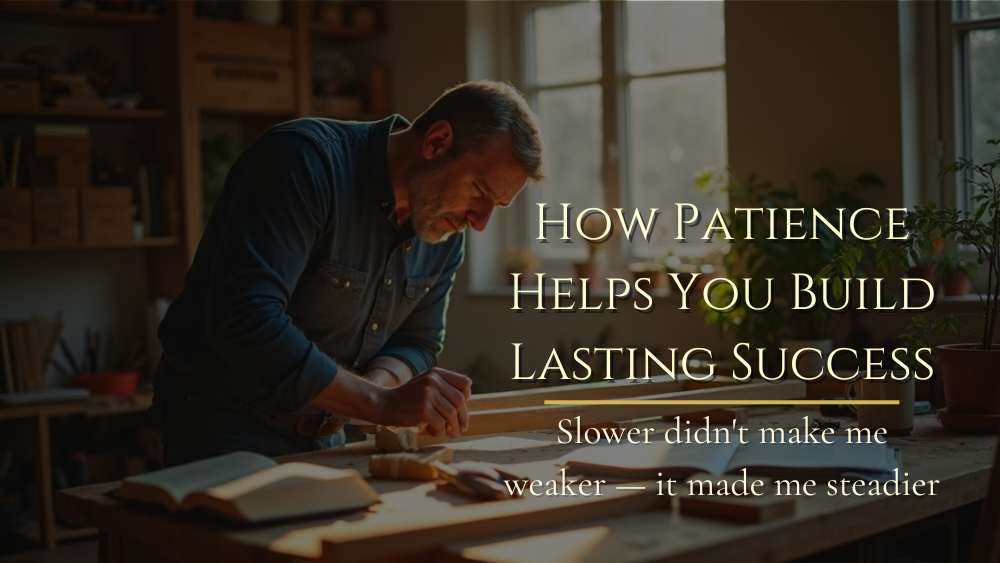
Patience does not delay real success. It helps build something that can last. For a long time, I thought urgency meant progress, but I am learning that speed can create motion without wisdom. This chapter is about slowing down enough to build with discipline, clarity, and sustainability.
When Rushing Felt Like Progress
There was a time when I believed speed was the same as momentum.
If I moved fast, I felt productive.
If I rushed decisions, I felt driven.
If I pushed harder, I assumed I was closer to success.
Urgency made me feel like I was doing something important.
It gave me the illusion of movement.
The illusion of control.
The illusion that pressure meant purpose.
But urgency has a way of disguising itself as discipline.
That is what I did not understand at first.
I thought I was being focused when I was really being impatient.
I thought I was being ambitious when I was really reacting to fear.
I thought I was building faster when I was actually creating more problems for myself to fix later.
Much of what I rushed into did not create lasting progress.
It created cleanup.
Rework.
Burnout.
Frustration.
Lessons I probably could have learned more gently if I had slowed down long enough to listen.
That connects closely to How Small Faithful Choices Shape Your Future, because lasting progress is rarely built through panic. It is built through repeated choices that can survive beyond the emotion of the moment.
What Patience Quietly Changed
When I slow down, better things tend to happen.
Decisions become clearer.
Habits become cleaner.
Outcomes become more stable.
I notice things I would have missed if I had rushed.
I ask better questions.
I make fewer emotional decisions.
I give ideas enough time to mature before forcing them into existence.
That has changed the way I understand progress.
Patience creates space to think instead of react.
It gives wisdom room to speak before urgency takes over.
It allows something to become ready instead of making it perform before it has roots.
I used to think patience meant waiting around.
Now I see patience as active restraint.
It is not laziness.
It is not fear.
It is not weakness.
It is the discipline to move at a pace that does not destroy what I am trying to build.
That lesson matters because most of the mistakes I regret were not made because I did not try hard enough.
They were made because I did not wait long enough.
The Cost of Rushed Success
Trying to rush success often creates sloppy habits.
Corners get cut.
Details get ignored.
Foundations get rushed.
Warning signs get explained away.
The process becomes more about getting there than becoming someone who can handle what “there” requires.
That kind of chaos can feel productive at first.
It feels like motion.
It feels like effort.
It feels like commitment.
But eventually, rushed success demands payment.
Usually in the form of rework.
Burnout.
Failure that could have been avoided.
Relationships strained by pressure.
Systems that cannot hold what they were built too quickly to carry.
I have lived enough of that to know I do not want to keep calling motion success.
Motion can look impressive while still moving in the wrong direction.
Speed can feel exciting while still weakening the foundation.
Urgency can make something happen faster while making it harder to maintain later.
That is why patience does not eliminate effort.
It redirects it.
It teaches me where effort actually belongs.
Not just in doing more.
But in doing what can last.
Redefining What Winning Looks Like
Success used to mean speed.
Now it means sustainability.
That shift has changed a lot for me.
I no longer only ask, “How fast can this happen?”
I ask different questions now.
Can this grow without constant pressure?
Can this survive without urgency?
Can this continue without exhausting everyone involved, including me?
Can I maintain this once the excitement fades?
Can this still matter when no one is clapping?
Can this become part of a life I actually want to live?
Those questions are slower.
But they are wiser.
Because if something only works when I am running on pressure, then it may not be success.
It may just be motion.
And I have lived enough motion.
I want fruit.
I want stability.
I want growth that does not require me to keep recreating crisis just to feel productive.
That connects naturally to How to Break the Workaholic Pattern as a Father, because urgency and overwork can both look responsible from the outside while quietly costing too much on the inside.
I do not want success that makes me less human.
I do not want progress that leaves me unavailable.
I do not want achievement that collapses because I built it faster than my character, habits, and peace could support.
Patience as a Form of Discipline
Waiting is not passive.
That is something I had to learn.
Waiting requires restraint.
Trust.
Humility.
Self-control.
The ability to admit that timing matters as much as talent.
That last part is hard for me.
Because talent can make me believe I should move faster.
Discipline can make me believe I should push harder.
Desire can make me believe that wanting something badly enough means it should happen now.
But patience reminds me that not everything is ready just because I am eager.
Some things need time.
Some ideas need refining.
Some habits need repetition.
Some doors need wisdom before they need effort.
Some seasons need maturity before movement.
Patience keeps me from building things I cannot maintain.
It forces me to value longevity over applause.
It asks me to care more about the structure than the speed.
That connects with How to Stay Consistent in Personal Growth Without Pressure, because consistency is one of the ways patience becomes visible. It is not about doing everything at once. It is about continuing faithfully without turning growth into another form of panic.
When Slower Feels Like Failure
Slowing down does not always feel peaceful at first.
Sometimes it feels like failure.
It can feel like falling behind.
Like losing momentum.
Like other people are passing me while I am still trying to build the right foundation.
That feeling is uncomfortable.
Especially when I am used to measuring progress by visible activity.
But I am learning that slower does not always mean stuck.
Sometimes slower means wiser.
Sometimes slower means the foundation is finally being built correctly.
Sometimes slower means I am refusing to repeat a pattern that used to wear me down.
Sometimes slower means I am choosing peace over performance.
That does not mean I stop working.
It means I stop worshiping urgency.
I still move.
I still build.
I still care.
I still show up.
But I am learning to stop treating pressure like proof that I am serious.
Pressure may get me moving.
Patience helps me build.
The Success I Am Choosing Now
Today, success looks quieter.
It looks like progress that does not unravel.
Habits that do not need fixing later.
Growth that does not come with chaos attached.
Decisions that still make sense after the emotion fades.
Work that can breathe.
A life that does not require constant emergency to feel meaningful.
That kind of success may not look as impressive at first.
It may not create the same rush.
It may not satisfy the part of me that wants proof right now.
But it feels steadier.
And steadier matters to me now.
Because I do not only want to reach something.
I want to become someone who can carry it well once I get there.
I want success that does not cost me my peace.
I want progress that does not depend on panic.
I want tomorrow to be shaped by wisdom, not just urgency.
Patience has not slowed my life down.
It has made it make sense.
What This Chapter Taught Me
Urgency can disguise itself as discipline.
Speed is not always the same as progress.
Rushed success often creates weak foundations, sloppy habits, and problems that demand payment later.
Patience is not passivity. It is restraint, trust, humility, and wisdom practiced over time.
I am learning that success should be sustainable.
If something cannot continue without constant pressure, exhaustion, or chaos, it may not be success at all.
It may only be motion.
And I am choosing something steadier now.
Scripture Reflection
“Also, that the soul be without knowledge, it is not good; and he that hasteth with his feet sinneth.”
— Proverbs 19:2
This verse fits this chapter because it connects haste with a lack of wisdom.
Desire by itself is not enough.
Effort by itself is not enough.
Speed by itself is not enough.
I need knowledge.
Timing.
Patience.
The humility to slow down before I miss the way.
That is what patience is teaching me now.
Not to stop moving.
To move with wisdom.
Continue the Story
These chapters continue the journey through patience, consistency, discipline, and building a future that can actually last:
-
How Small Faithful Choices Shape Your Future
For understanding how tomorrow is built through repeated choices that may feel small while they are happening. -
How to Stay Consistent in Personal Growth Without Pressure
For learning how growth can continue without turning into another burden to perform. -
How to Break the Workaholic Pattern as a Father
For reflecting on success, pressure, presence, and refusing to build a future that costs the people you love.
Move Through This Book