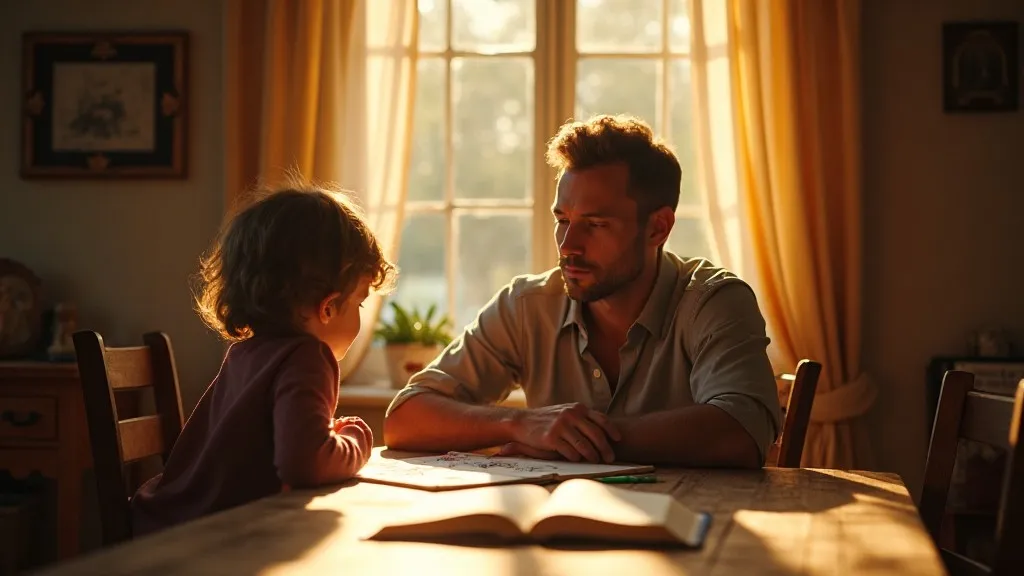
Growing up, discipline was simple and absolute.
Bad behavior meant physical punishment.
Not time-outs.
Not lost privileges.
Not long conversations.
Not patient explanation.
I did not learn boundaries through understanding.
I learned them through fear.
That kind of lesson stays with you. It follows you into adulthood. It follows you into fatherhood. It shows up in the moments when your children disobey, push limits, ignore correction, or make the same mistake again after you thought they understood.
This chapter is about what happens when childhood punishment shapes the way you think about discipline as a father.
And why I am trying to choose a different way.
What Pain Taught Me
As a child, punishment often ended behavior quickly.
That much is true.
Fear can stop a child from doing something again. Pain can create immediate compliance. A child can learn very quickly that certain actions bring consequences they do not want repeated.
But stopping behavior is not the same as teaching wisdom.
Pain did not always help me understand why something was wrong.
It did not build trust.
It did not explain character.
It did not teach emotional regulation.
It did not make correction feel safe.
It taught me to avoid danger.
It taught me to comply.
And there is a difference between compliance and character.
That difference matters to me now because I am not only trying to raise children who behave when I am nearby. I am trying to raise children who can make wise choices when I am not there to control the moment.
That connects closely to What Children Learn From Their Father Without Being Taught, because children are always learning from more than our instructions. They learn from our tone, our reactions, our patience, and the kind of power we choose to use.
What Pain Did Not Teach Me
Pain taught me what not to repeat.
But it did not always teach me what to do instead.
That is one of the harder parts of breaking a pattern. You can know what harmed you and still feel unsure about the healthier replacement.
I know I do not want fear to be the foundation of discipline in my home.
But I also know children still need correction.
They need structure.
They need limits.
They need consequences.
They need someone willing to say no.
Gentleness cannot mean avoiding every hard moment. Care cannot mean letting everything pass. Patience cannot become passivity just because I am afraid of being harsh.
That is the tension I carry.
I do not want to wound my children in the name of discipline.
But I also do not want to leave them unprepared because I was too afraid to correct them firmly.
Doing the Opposite on Purpose
Many things learned in childhood follow us into adulthood.
Other things push us in the opposite direction.
For me, discipline became something I approached with hesitation instead of instinct.
There have been a few moments when I have spanked my children.
Those moments weigh on me.
They do not feel corrective in my memory. They feel like failure. Not because I believe every parent who has ever spanked a child is evil or careless, but because I know where that road came from in my own story.
I know what fear did inside me.
So when my mind even moves in that direction, it saddens me.
It feels less like discipline and more like an old pattern trying to survive through me.
That is why How to Break Generational Patterns as a Father belongs in this path. Breaking patterns is not only about rejecting the past. It is about learning what to build in its place.
The Gentler Path Is Not Always Simple
So I lead with care.
Conversation.
Guidance.
Patience.
Presence.
Repetition.
Most of the time, physical punishment is not even a thought.
But I would be lying if I said the gentler path always feels clear.
Sometimes I wonder if I am doing enough.
Would my children be better behaved if I used less care and more toughness?
Would stricter discipline create clearer boundaries?
Have I overcorrected?
Am I being patient, or am I being permissive?
Those questions are not rooted in anger.
They are rooted in responsibility.
I do not want obedient children only.
I want capable children.
But I also do not want kindness to become a disguise for weak boundaries.
That balance is harder than it sounds.
That is where How to Discipline Your Children Without Breaking Trust becomes important. Discipline still matters. The question is whether correction can guide a child without making love feel unsafe.
Letting Life Teach What I Do Not Need to Force
Recently, a conversation stayed with me.
Sometimes, children need room to explore.
Sometimes, they need to experience natural consequences. Not dangerous consequences. Not neglect. Not punishment disguised as freedom.
Just life teaching them that a choice had a result.
No lecture.
No manufactured consequence.
No need for me to turn every mistake into a speech.
Just reality saying:
That was a bad idea.
There is something powerful about that kind of lesson.
It does not come from fear of me. It comes from experience. It helps them connect choice to outcome without making me the source of every painful lesson.
Of course, that requires wisdom.
A parent cannot let life teach everything. Some risks are too serious. Some boundaries need to be set before harm happens. Some situations require immediate correction.
But not every lesson has to come through force.
Some lessons are stronger when children are allowed to feel the natural weight of their choices in safe, age-appropriate ways.
Discipline Without Damage
“Folly is bound up in the heart of a child, but the rod of discipline will drive it far away.”
— Proverbs 22:15
I do not read that verse as permission to harm.
I read it as a reminder that discipline matters.
Children are not born already wise. They need guidance. They need correction. They need loving authority. They need someone willing to help shape what immaturity cannot yet understand.
But the form discipline takes requires wisdom.
Discipline should guide, not scare.
Correct, not crush.
Shape, not scar.
Teach, not terrify.
Faith does not give me permission to repeat pain just because pain was once called discipline.
It calls me to wisdom.
And wisdom asks harder questions than fear does.
What I Am Still Learning
I am still learning what discipline should look like in practice.
I am learning that calm correction is still correction.
I am learning that patience does not mean weakness.
I am learning that a boundary can be firm without being cruel.
I am learning that children need consequences, but they also need connection strong enough to survive those consequences.
I am learning that my fear of becoming harsh cannot make me afraid to lead.
And I am learning that my fear of being too soft cannot make me comfortable with passing down pain.
That is part of How Fatherhood Teaches Patience Through Everyday Moments, because so much of discipline happens in repeated, ordinary moments where patience has to be practiced before wisdom can be heard.
What I Am Choosing for Now
For now, I choose care over fear.
I choose guidance over force.
I choose presence over power.
That does not mean I have parenting figured out.
It means I am paying attention.
Fatherhood has taught me that discipline is not only about controlling behavior. It is about shaping a person who can function when control is gone.
That kind of shaping takes more than punishment.
It takes patience.
Consistency.
Correction.
Love.
Structure.
Repair.
And while I still question myself, I know this much:
I refuse to pass down pain simply because it once passed through me.
Continue the Story
- How to Discipline Your Children Without Breaking Trust
How correction can guide children without making love feel unsafe or fragile. - How to Break Generational Patterns as a Father
How fatherhood can become the place where old patterns are interrupted instead of repeated. - What Children Learn From Their Father Without Being Taught
How children absorb tone, patience, fear, love, and responsibility through the way a father lives.
Move Through This Book