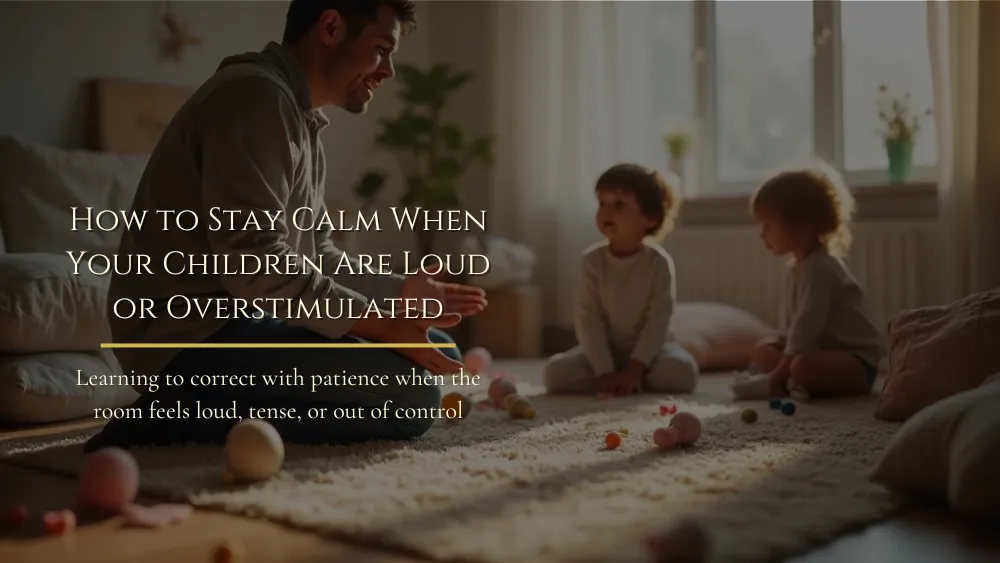
Staying calm when your children are loud or overstimulated can be harder than it sounds. The noise, the arguing, the rough play, the screaming, and the pressure to “do something” can make a parent feel like the only way to regain control is to get louder.
But fatherhood keeps teaching me that calm is not weakness.
Sometimes calm is leadership.
This chapter is for parents who are trying to correct their children without becoming the loudest, most chaotic person in the room.
When Play Turns Into Too Much
There are moments in my house where play starts out harmless.
One child wants to play fight. Another child takes it more seriously than expected. What begins as roughhousing can quickly become real frustration, real yelling, and real tension.
That is when fatherhood stops being an idea and becomes a decision.
Do I react to the noise?
Do I match the energy?
Do I raise my voice because the room feels out of control?
Or do I slow myself down long enough to respond in a way that actually helps?
Most of the time, I can stay calm. I can talk to my children with kindness and respect, even when their behavior is difficult. I can separate them when I need to. I can redirect the situation. I can lower my voice and help the room settle.
But not always.
Sometimes I lose my temper.
Sometimes I get louder than I wanted to.
Sometimes I feel the pressure to provide “tough love,” even when something inside me knows that harshness is not what the moment needs.
That is the tension this chapter lives inside.
Not perfect parenting.
Honest parenting.
The Pressure to Discipline Harshly
One of the hardest parts of parenting is not always the children.
Sometimes it is the pressure around parenting.
There are moments when I feel like I am expected to be harsher than I naturally want to be. Like correction only counts if it looks strong enough from the outside. Like gentle parenting might be mistaken for weakness. Like love, patience, and understanding are not enough unless they are backed by a raised voice.
That pressure can make discipline confusing.
Because I do believe children need correction.
They need structure.
They need boundaries.
They need consequences.
They need guidance.
But I also know what it feels like when discipline becomes fear.
As a child, I was often rushed into punishment without being allowed to explain. Consequences came before understanding. Correction did not always feel like teaching. Sometimes it felt like pain arriving before anyone cared what actually happened.
That shaped me.
It is one reason I do not want my children growing up with the same heartbreak I carried.
This is why How Childhood Punishment Shapes the Way You Discipline as a Father matters in this journey. The way we were corrected as children can quietly shape what we fear, repeat, resist, or overcorrect as parents.
I do not want to repeat what hurt me.
But I also do not want my fear of being harsh to keep me from leading well.
That balance is hard.
Different Children Need Different Responses
One thing fatherhood has taught me is that children are not all corrected the same way.
A raised voice may get one child’s attention.
For another child, it can make everything worse.
One of my children handles stimulation differently. When the room gets loud, or voices get sharp, he can become more overwhelmed instead of calmer. A raised voice does not help him regulate. It pushes him further away from listening.
So I have learned to lower my voice.
Not because the behavior does not matter.
Because the child matters.
A calm, soft, low voice reaches him better than force does. It gives him something steady to respond to when his own emotions are already too high.
That does not mean every moment is easy.
It means I have had to learn that parenting is not only about what I want to say. It is also about what my child can actually receive in that moment.
Some children need firmness.
Some need space.
Some need fewer words.
Some need separation.
Some need a calm adult more than they need a louder command.
That is one reason discipline cannot be only about control. It has to include wisdom.
Loud Correction Can Add to the Chaos
I am still learning that harsh discipline often does not work the way people think it does.
You cannot teach children to be calm by becoming chaos.
You cannot teach them to be less loud by becoming louder in a way that scares or overwhelms them.
You cannot teach respect while modeling disrespect.
You cannot teach emotional control while showing them that the adult has lost control.
That does not mean a parent should never raise their voice.
There are moments when urgency matters. There are moments when safety requires immediate correction. There are moments when a firm voice is necessary.
But there is a difference between using a strong voice to protect and using a loud voice because I have lost patience.
That difference matters.
A strong voice says, “This needs to stop.”
An uncontrolled voice says, “I am no longer leading myself.”
And children feel that difference.
They may not have the words for it, but they absorb it.
That connects closely to What Children Learn From Their Father Without Being Taught, because children do not only learn from our instructions. They learn from our tone, our reactions, our repair, and the way we handle pressure.
When I become louder than the lesson, they may remember my volume more than my wisdom.
That is not what I want.
Calm Does Not Mean Permissive
I think some people misunderstand calm parenting.
They hear “gentle” and think it means passive.
But calm does not mean permissive.
Calm does not mean children get to do whatever they want.
Calm does not mean there are no consequences.
Calm does not mean a parent avoids correction because correction feels uncomfortable.
Calm means I am trying to lead the room instead of letting the room lead me.
I can separate my children.
I can end the rough play.
I can give consequences.
I can explain what needs to change.
I can require respect.
I can set a boundary.
But I can do those things without turning discipline into fear.
That is the kind of fatherhood I am trying to practice.
Not soft in the sense of weak.
Soft in the sense of safe.
Firm in the sense of steady.
Loving in the sense of present.
When I Do Not Get It Right
I wish I could say I always get this right.
I do not.
There are times when I raise my voice too quickly. Times when I feel pressure to discipline harder than I believe is helpful. Times when I react, then feel the weight of guilt afterward.
That guilt is heavy.
It is not because I think children should never be corrected.
It is because I know how easily correction can become something a child carries as pain instead of guidance.
When I over-discipline, I do not feel powerful.
I feel ashamed.
Because I know what it felt like to be a child on the other side of harshness. I know what it felt like when adults cared more about punishment than understanding. I know what it felt like to feel isolated instead of guided.
So when I see even a shadow of that in myself, it hurts.
But guilt alone cannot be the end of the story.
Guilt has to become repair.
It has to become reflection.
It has to become a better next response.
That is part of How to Discipline Your Children Without Breaking Trust. Discipline is not only about stopping behavior. It is about correcting in a way that still leaves the relationship safe enough for a child to come back.
What I Want My Children to Learn
More than anything, I want my children to know they can come to me.
If they make a mistake, I do not want them to hide.
If they are overwhelmed, I do not want them to feel alone.
If they are wrong, I want them to know correction does not mean rejection.
If they are scared, I want them to believe their father is still safe.
That matters to me because I know what hiding feels like.
I know what it feels like to carry shame alone.
I know what it feels like when punishment teaches silence instead of growth.
So I want something different for my children.
I want them to learn love.
I want them to learn kindness.
I want them to learn compassion.
I want them to learn how to raise their own children one day without thinking fear is the only way to create respect.
That kind of legacy does not happen by accident.
It happens in loud rooms.
It happens when I am tired.
It happens when children are overstimulated.
It happens when another adult expects me to be harsher.
It happens when I choose the kind of father I want to be before the moment chooses for me.
A Gentle Answer Still Leads
Scripture says:
“A gentle answer turns away wrath, but a harsh word stirs up anger.”
— Proverbs 15:1
That verse does not tell me to avoid correction.
It reminds me that my tone can either calm the room or stir it up.
A gentle answer does not mean there is no boundary.
It means the boundary is carried by wisdom instead of anger.
A harsh word may get attention, but it can also create more fear, more resistance, more shame, or more chaos.
I have seen that in my own parenting.
I have seen calm work where force would have failed.
I have seen a lower voice reach a child that yelling would have pushed further away.
I have seen how much power there is in choosing not to escalate.
What This Chapter Is Teaching Me
This chapter is teaching me that calm is not weakness.
It is self-control.
It is leadership.
It is love with structure.
It is correction without cruelty.
I am learning that each child may need something different from me, and that fairness does not always mean responding to every child the exact same way.
I am learning that harsh discipline can stop a behavior for a moment while still damaging trust for much longer.
I am learning that children need boundaries, but they also need a father whose presence does not feel unsafe when they are overwhelmed.
And I am learning that the father I want to be is not built in the quiet moments only.
He is built when the room is loud.
When the children are overstimulated.
When pressure rises.
When old patterns whisper that harshness is strength.
That is where I have to choose again.
I do not always get it right.
But I know what I am reaching for.
I want my children to remember a father who corrected them, guided them, and loved them without making fear the center of the lesson.
Because if I want them to grow into calm, compassionate people, I cannot only demand calm from them.
I have to model it first.
Continue the Story
-
How to Discipline Your Children Without Breaking Trust
How correction can guide children without making love feel unsafe or fragile. -
How Fatherhood Teaches Patience Through Everyday Moments
How ordinary parenting moments become the place where patience is practiced in real time. -
How to Break Generational Patterns as a Father
How fatherhood can become the place where old patterns are interrupted instead of repeated.
Move Through This Book