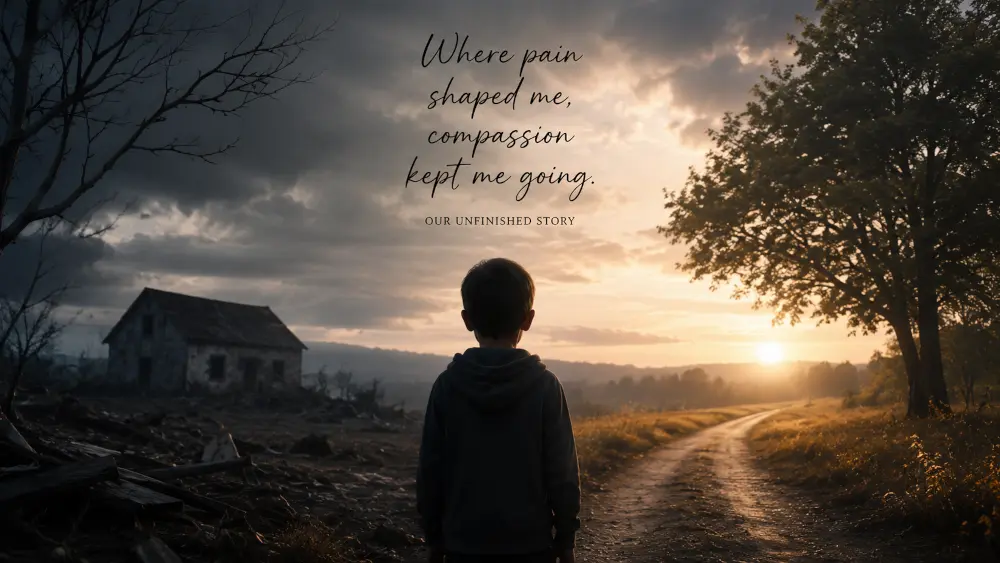
How Childhood Trauma Shapes Who You Become
Childhood trauma doesn’t just stay in the past. It can shape how safe you feel in relationships, how deeply you trust, how you respond to conflict, and how you understand yourself years later.
If you’ve ever wondered why your reactions feel bigger than the moment, why rejection cuts so deeply, or why peace can feel unfamiliar, this chapter is about understanding how early pain can shape who you become—and how those early experiences shaped me.
Childhood trauma shapes identity in ways most people don't recognize at first. It can influence:
- how safe you feel in relationships
- whether you expect love or fear it
- how you respond to conflict, rejection, or silence
- the habits you build to protect yourself
For me, it didn't just affect what I went through.
It shaped how I became.
This is my story.
My story doesn't begin with comfort, celebration, or the warmth of being wanted. It begins in the shadows—in the places where a child should never have learned to live. Those early years left marks I never asked for, wounds I didn't have the language to describe, and memories that still press against me when life echoes too loudly.
I was abused.
I was locked away.
I was abandoned.
That's the truth, but it's not the whole story.
Because the details of what happened to me are far less important than what those years created inside of me.
They shaped the way I love.
They shaped the way I protect.
They shaped the way I see the world—quietly, gently, intentionally.
That early shaping connects closely to what childhood neglect looks like before you realize it, because some wounds do not feel like wounds while you are living them. Sometimes they feel like normal life until adulthood gives you the language to understand what was missing.
My beginnings were filled with pain.
But they also forged the tenderness I carry today.
The Kindness That Grew From Hurt
People sometimes ask why I'm so gentle, why I care so deeply, why I try so hard to make others feel safe.
The answer is simple:
I know what it feels like to grow up afraid.
I learned early that cruelty doesn't make a person powerful. It only reveals their brokenness.
So I chose the opposite path.
Where there was fear in my childhood, I chose to become peace.
Where there was silence, I learned to listen.
Where there was hunger, I learned to give.
Where there was neglect, I learned to show up.
Kindness wasn't taught to me.
It was carved out of the emptiness I lived through.
That does not make the pain good. It does not make what happened acceptable. It simply means pain did not get the final word in who I became.
Some people survive hurt by hardening.
I survived by learning how deeply I never wanted to become what hurt me.
Survival Became My First Language
Before I knew how to explain what I was feeling, I knew how to survive.
I knew how to read a room.
How to listen for changes in tone.
How to stay quiet when attention felt unsafe.
How to become smaller when being noticed carried consequences.
Those habits did not arrive as personality traits.
They arrived as protection.
A child does not always know he is adapting. He just learns what keeps him safer. He learns when to speak, when to disappear, when to hold emotion inside, and when not to expect comfort from the people who should have offered it.
That survival pattern is something I explore more in how childhood emotional neglect teaches you to survive, because emotional neglect does not only remove comfort. It teaches the nervous system how to live without expecting it.
Survival helped me endure.
But survival also followed me.
It followed me into relationships.
Into conflict.
Into silence.
Into the way I carried pain without asking anyone to help me hold it.
That is one of the hardest parts of healing childhood trauma. You are not only healing what happened.
You are also learning how to stop living as if it is still happening.
Surviving a Winter No Child Should Face
By seventeen, I was alone in the world.
No home.
No bed.
No one checking if I was alive.
I survived a Michigan winter by learning how to breathe through the cold, how to keep going when my body begged to stop, and how to keep believing that life had more for me than the circumstances I was handed.
I shouldn't have survived.
But I did.
And that season gave me two things I still carry:
A resilience I don't always recognize in myself.
A deep compassion for anyone who is fighting battles in silence.
I know what it means to sleep where you can, pray for warmth, and fight for a future you can't yet see.
It made me someone who notices the struggle behind people's eyes.
It also taught me that survival is not always dramatic from the outside. Sometimes survival looks like getting through one more night. Taking one more step. Finding one more reason not to give up.
That chapter of my life connects to what it’s like to be homeless at 17, where survival became more than an idea. It became the reality I had to live through.
When Achievement Arrives in an Empty Room
I was well-educated, not because I was supported, but because I refused to let my circumstances decide my future.
I earned a black belt.
I earned hundreds of medals.
I pushed myself through tournaments across states, competing on global stages.
No one from home showed up.
Not once.
And yet, the absence of applause taught me a truth that shaped my entire adulthood:
Success means more when you build it without witnesses.
Those lonely victories didn't break me. They shaped a man who celebrates others fiercely because he knows what it feels like to stand alone on a podium with no one in the stands.
That kind of discipline was not born from ambition alone. It was born from necessity. When support is missing, discipline can become the structure you build around yourself.
That lesson connects closely to how discipline became my survival, because discipline helped me keep moving when encouragement, safety, and celebration were absent.
But I also understand now that achievement cannot replace being loved.
Success can prove what you survived.
It cannot give back what should have been there.
The Friend I Lost Too Soon
When my training partner—my closest friend—died in a DUI accident, part of my youth died with him.
I was in the car with his parents.
I remember the quiet more than the chaos.
The disbelief.
The heaviness.
The way grief can make the air feel harder to breathe.
His loss taught me that life is fragile, unpredictable, and painfully short.
It also taught me why relationships matter so deeply to me now—why I hold on tightly, why I love fully, why connection is sacred.
When you lose someone that young, you learn early that tomorrow is not promised.
You learn that people can be here one moment and gone the next. You learn that ordinary days are not as ordinary as they seem. You learn that love should not be delayed forever because life does not always give warning before it changes.
That grief did not replace the wounds that came before it.
It added another layer.
Another reason connection became precious.
Another reason loss became something my heart recognized too quickly.
Why the Past Still Echoes
I don't talk about these things to gain sympathy.
I talk about them because they explain the parts of me people sometimes misunderstand.
Why certain moments still trigger old memories.
Why rejection cuts deeper than it should.
Why raised voices make my heart race.
Why I lose composure when someone reminds me of the life I fought to escape.
Why I am so protective of peace.
Why I love with intensity.
I'm not always reacting only to the moment.
Sometimes I am reacting to years of surviving things I never should have faced.
Healing is not forgetting.
Healing is learning to breathe through the echoes and remind yourself that you are no longer that child.
That is why why my body reacted before I understood the danger matters in this journey. Sometimes the body remembers threat before the mind can explain why the moment feels unsafe.
Understanding that has helped me carry more compassion for myself.
Not excuses.
Compassion.
Because there is a difference between refusing responsibility and finally understanding why certain wounds still echo.
What My Beginnings Truly Made Me
My childhood could have hardened me.
It could have made me bitter, angry, or cold.
But somehow, God held onto the pieces of my heart that the world tried to break.
He shaped my pain into compassion.
He shaped my loneliness into presence.
He shaped my hunger into generosity.
He shaped my wounds into wisdom.
He shaped my silence into a voice that speaks gently, because it remembers what it felt like to be unheard.
This is where my story truly begins.
Not in what was done to me.
But in what those years built within me.
A resilience I didn't know I had.
A kindness deeper than the hurt.
A heart that still loves, still hopes, still believes.
The beginning of my life wasn't beautiful.
But it was the soil where something beautiful began to grow.
I remember nights where silence didn't feel peaceful. It felt like something waiting to happen.
And if you recognize yourself in any of this, you're not broken.
You're responding exactly the way someone would who had to learn survival too early.
"The Lord is close to the brokenhearted and saves those who are crushed in spirit."
What This Chapter Taught Me
Childhood survival patterns do not disappear just because we grow older.
Pain can shape compassion instead of bitterness.
Healing often begins with understanding why certain wounds still echo.
The child who learned survival too early still deserves gentleness now.
I am learning that my past explains me, but it does not have to imprison me. What happened shaped my nervous system, my relationships, my fears, my strength, and my tenderness—but it does not get to decide every chapter that follows.
Healing doesn't start with forgetting.
It starts with understanding.
And sometimes understanding sounds like this:
I was hurt.
I survived.
I adapted.
I became.
And I am still allowed to heal.
Even in the parts of my story that felt unseen, I wasn't as alone as I thought.
Continue the Story
- What Childhood Neglect Looks Like Before You Realize It
How early neglect can feel normal before adulthood gives you language for what was missing. - How Discipline Became My Survival
How survival taught me discipline, endurance, and strength—but not always peace. - Why My Body Reacted Before I Understood the Danger
How the body can remember fear before the mind understands why a moment feels unsafe.
Move Through This Book