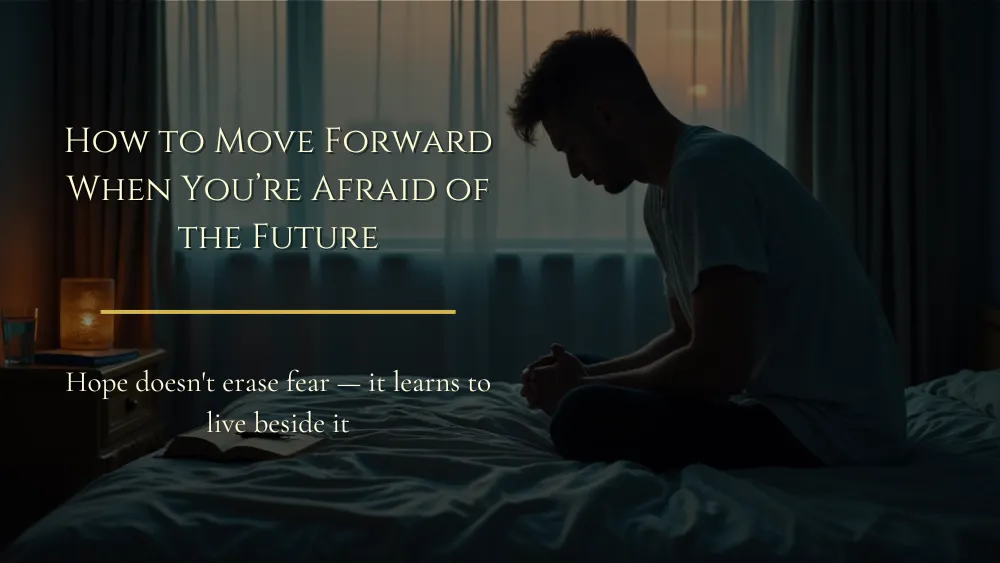
Being afraid of the future does not always mean you lack faith. Sometimes it means you have lived through enough disappointment to know that tomorrow can feel risky. This chapter is about honest hope, quiet fear, and learning how to keep moving forward without pretending you are fearless.
Saying the Quiet Part Out Loud
I do not always trust the future.
Even when I write about hope.
Even when I talk about patience.
Even when I say I am learning to let things unfold.
There is still a part of me that expects tomorrow to disappoint me.
Not because I lack faith.
Not because I have given up.
But because experience taught me to brace for impact.
That is the quiet part I do not always like admitting.
I can believe God is good and still feel nervous about what life may bring next.
I can write about hope and still feel afraid of wanting too much.
I can talk about trust and still struggle when the outcome is unknown.
That does not make the faith fake.
It makes the fear honest.
And maybe honesty is where this kind of healing has to begin.
The Fear of Repeating Myself
What I am most afraid of is not failure.
It is repetition.
I am afraid of choosing the same patterns with new names.
Afraid of mistaking familiarity for safety.
Afraid of believing I have healed more than I actually have.
Afraid of walking into a future that only looks different on the surface.
That fear is uncomfortable because it forces me to look at myself honestly.
It asks whether I am growing or only renaming old reactions.
It asks whether I am trusting God or trying to control the story so I never have to feel exposed again.
That is one reason What Faith Teaches You About Letting Go of Control connects so closely to this chapter. Control can feel like wisdom when fear is underneath it. But sometimes what I call preparation is really protection from being hurt again.
I do not want to repeat myself.
I do not want to carry old wounds into new doors.
I do not want to confuse movement with growth.
And yet, I know fear cannot be my only guide.
If fear leads every decision, then the future becomes smaller before it even arrives.
When Hope Feels Risky
Hope asks me to lower defenses I built for survival.
That is what makes it hard.
It asks me to stop scanning for exits before anything has even gone wrong.
To stop preparing explanations for disappointment.
To stop assuming that wanting something means I will lose it.
That kind of hope feels dangerous.
Not because hope is foolish.
Because hope makes me visible.
And visibility has cost me before.
When you have been disappointed enough, hope can start to feel like standing in an open field with nowhere to hide. You are no longer protected by indifference. You are no longer pretending you do not care.
You are admitting that something matters.
That you want tomorrow to be good.
That you are still willing to believe there may be life ahead worth walking toward.
That is brave.
Even when it shakes.
This is where How to Keep Hope When You Can’t Control the Outcome belongs in the story. Hope becomes healthier when it stops trying to force proof from the future. I can want what is ahead without gripping it so tightly that I damage it before it has time to grow.
Trusting God While Distrusting Outcomes
I trust God more than I trust outcomes.
That feels strange to admit.
But it is true.
I believe God is good.
I believe He is present.
I believe He has carried me through things I did not know how to survive.
But I am not always sure life will cooperate.
I am not always sure people will stay.
I am not always sure plans will hold.
I am not always sure my own heart will know what to do when something good feels possible again.
So my faith right now is not always bold or loud.
Sometimes it is quiet.
Cautious.
Careful.
Still learning how to stay.
I used to think faith had to sound confident all the time.
Now I am learning that faith can tremble and still be real.
Faith can whisper.
Faith can walk slowly.
Faith can admit, “God, I trust You, but I am scared.”
That kind of prayer may not sound impressive.
But it may be one of the most honest prayers I know how to pray.
Letting Fear Sit at the Table
I am learning that vulnerability does not require me to banish fear.
It asks me to stop pretending fear is not there.
That matters because pretending has never healed me.
Pretending only made me perform a version of strength that could not tell the truth.
Fear does not get to drive.
But it does get to exist.
I can acknowledge it without obeying it.
I can listen to what it is trying to protect without letting it decide the entire direction of my life.
Sometimes fear is not an enemy.
Sometimes fear is a witness.
It points to where I was hurt.
Where I still feel exposed.
Where trust still feels unfinished.
Where hope still needs gentleness.
That does not mean fear is always right.
It only means fear is telling me something about the places inside me that still need care.
And somehow, acknowledging it makes tomorrow feel more real.
Less imagined.
Less rehearsed.
Less fake.
I do not have to act fearless to move forward.
I just have to stop letting fear be the final voice.
Moving Forward While Still Afraid
I do not have fearless hope.
I have honest hope.
Hope that shakes sometimes.
Hope that checks the ground before stepping.
Hope that wonders if it is safe to want again.
Hope that moves forward anyway.
That connects naturally to How to Move Forward When the Future Feels Unclear, because the path ahead does not always become clear before courage is required. Sometimes clarity comes after the step, not before it.
I wish I could say I always feel ready for tomorrow.
I do not.
Some days, I feel strong.
Other days, I feel like I am carrying every old disappointment into a future I have not even reached yet.
But I am learning that fear does not automatically mean stop.
Sometimes fear simply means the step matters.
Sometimes it means my heart is entering territory it cannot control.
Sometimes it means I am growing past the places where survival used to keep me small.
That kind of movement is not dramatic.
It is quiet.
One decision at a time.
One honest prayer at a time.
One step taken without needing to prove I am no longer afraid.
What This Chapter Taught Me
Being afraid of the future does not mean my faith is gone.
It means there are still parts of me learning how to trust.
Hope does not erase fear.
It learns to live beside it.
I do not need to pretend I am fearless before I can keep moving forward.
I can be honest about what scares me and still choose faith.
I can admit that tomorrow feels uncertain and still believe God will meet me there.
If the next part of my story is going to be written, it will not be because I never felt afraid.
It will be because I stayed.
Because I kept walking.
Because I trusted God with trembling hands.
And for now, that feels like enough.
Scripture Reflection
“What time I am afraid, I will trust in thee.”
— Psalm 56:3
This verse fits this chapter because it does not shame fear.
It names it.
It gives fear a place in the sentence without giving it the final word.
“When I am afraid” means fear may still come.
“I will trust in thee” means fear does not have to lead.
That is the kind of faith I am learning now.
Not fearless faith.
Honest faith.
The kind that admits what is true and still turns toward God.
Continue the Story
These chapters continue the journey through fear, hope, trust, and learning how to face tomorrow honestly:
-
How to Move Forward When the Future Feels Unclear
For learning to take the next step when clarity comes slowly. -
How to Keep Hope When You Can’t Control the Outcome
For holding hope with patience instead of pressure. -
What Faith Teaches You About Letting Go of Control
For trusting God when control feels safer than surrender.
Move Through This Book