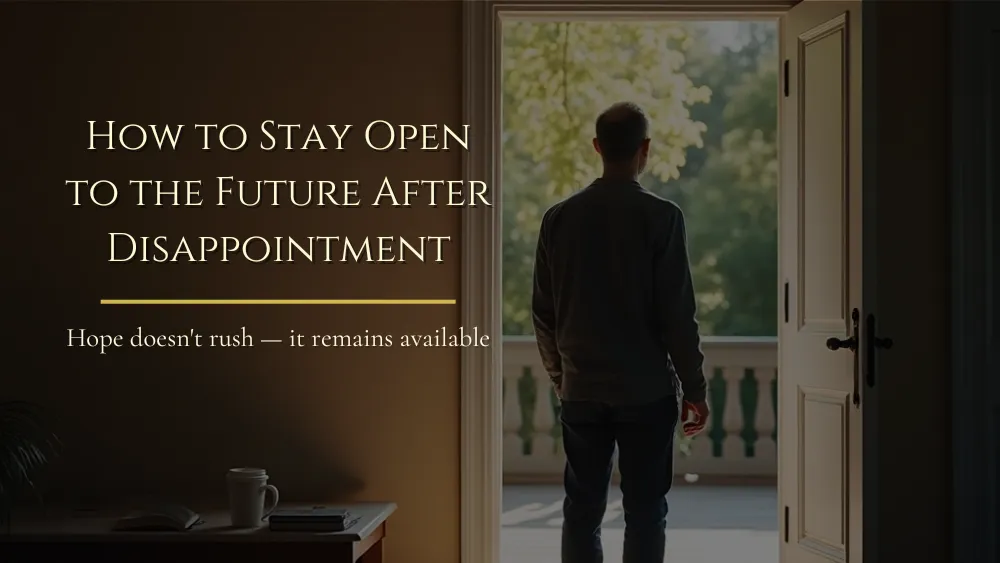
After disappointment, staying open to the future can feel risky. Hope can feel like something you have to defend, explain, or protect from being embarrassed again. This chapter is about learning how to remain open to what comes next without becoming naive, rushed, or closed off by what already happened.
When Hope Stops Defending Itself
There was a time when hope felt like something I had to justify.
If I hoped, I needed reasons.
If I trusted, I needed evidence.
If I believed tomorrow could be good, I felt the need to explain why.
I wanted proof before I allowed myself to expect anything gentle from the future.
Maybe that was protection.
Maybe it was fear.
Maybe it was both.
After enough disappointment, hope can start to feel irresponsible. You begin to question whether wanting something good is wisdom or weakness. You wonder if staying open means setting yourself up to be hurt again.
But lately, that pressure has started to fade.
Not because I have every answer.
Not because I know exactly what tomorrow will bring.
But because I am learning that hope does not need to argue its case every day.
It can simply exist.
Quiet.
Grounded.
Available.
Hope does not need to rush to prove it is real.
And it does not need to close itself off just because disappointment happened before.
Learning to Stay Open Without Being Naive
Staying open does not mean ignoring reality.
That is important for me to remember.
It does not mean pretending every door is safe.
It does not mean trusting every person too quickly.
It does not mean calling every opportunity good just because it feels exciting.
Openness without discernment can become recklessness.
But discernment without openness can become fear.
I am learning there is a healthier place between the two.
Staying open means refusing to let past disappointment close every door.
It means believing wisdom and hope can coexist.
It means allowing possibility without demanding certainty.
It means I can move slowly without shutting down completely.
That lesson connects naturally to How to Keep Hope When You Can’t Control the Outcome, because hope becomes healthier when it stops trying to force proof from tomorrow. I can stay open without gripping the future by the throat.
That is new for me.
For a long time, I thought openness meant exposure.
Now I am learning it can also mean courage.
Confidence That Is Not Loud
There is a kind of confidence that announces itself.
It wants to be seen.
It wants to sound certain.
It wants to convince everyone, including itself, that fear is gone.
But there is another kind of confidence.
The kind that settles quietly.
The kind that does not need guarantees.
The kind that keeps showing up without making a speech about it.
That is the confidence I am starting to respect more.
It does not rush outcomes.
It does not force timelines.
It does not panic when growth is subtle.
It trusts that something can be real even before it becomes obvious.
This kind of confidence is not loud because it does not need to perform.
It is the confidence of someone who knows they do not have to arrive all at once.
That connects to How Small Faithful Choices Shape Your Future, because confidence is often built through repeated faithfulness, not dramatic certainty.
I do not need to feel completely ready.
I do not need to know how every part of the story unfolds.
I just need enough trust to stay open today.
Letting Tomorrow Surprise Me
I do not need to predict how tomorrow will unfold.
That is hard for me because prediction feels safer than surprise.
If I can imagine every possible outcome, maybe I can protect myself from being caught off guard.
But life does not work that way.
Some of the best moments in my life arrived unannounced.
Not because I planned perfectly.
Not because I controlled every variable.
Not because I forced the timing.
They came because I stayed open long enough to receive them.
That matters.
Because disappointment can teach the heart to pre-reject joy before it arrives.
It can make you suspicious of good things.
It can make you assume that anything hopeful must have a hidden cost.
It can make you close the door before anyone even knocks.
I understand that instinct.
I have lived with it.
But I do not want fear to become the way I protect myself from blessing.
Tomorrow does not have to be scripted to be meaningful.
Sometimes it just needs space.
Hope That Remains Available
Hope does not always look dramatic.
Sometimes it looks like showing up.
Staying curious.
Remaining gentle.
Refusing to shut down when shutting down would feel safer.
Sometimes hope looks like leaving a little room in your heart for the possibility that life may still surprise you.
Not because you are naive.
Because you are not finished.
That kind of hope does not exhaust me the way forced hope used to.
It does not demand that I smile through uncertainty.
It does not ask me to pretend I have never been hurt.
It simply asks me to remain available.
Available to growth.
Available to grace.
Available to something good arriving differently than I expected.
Available to a future I do not have to control before I can receive it.
That kind of hope feels quieter.
But stronger.
When the Past Tries to Close the Door
The past has a way of making arguments.
It says, “Remember what happened last time.”
It says, “Do not get too comfortable.”
It says, “Do not want too much.”
It says, “Stay ready to be disappointed.”
And sometimes, the past is not entirely wrong to speak.
It remembers pain.
It remembers lessons.
It remembers doors that should have never been opened.
But the past should not be allowed to become the only voice in the room.
There is wisdom in remembering.
There is danger in letting memory become a prison.
I am learning that healing does not mean forgetting what hurt me.
It means refusing to let what hurt me decide every future possibility.
That connects with How to Move Forward When You’re Afraid of the Future, because fear may still come with me, but it does not get to close every door before God has a chance to open one.
The past can inform me.
It cannot lead me forever.
Choosing Hope as a Daily Posture
Hope is becoming less of a feeling for me and more of a posture.
A way of standing.
A way of waiting.
A way of remaining open without losing myself.
Some days I feel hopeful.
Some days I feel cautious.
Some days I feel both.
But I am learning that hope does not have to be loud to be alive.
It can be quiet and still be real.
It can be careful and still be open.
It can move slowly and still be moving.
It can wait without becoming bitter.
It can trust without demanding a timeline.
That kind of hope feels different from the hope I used to carry.
It is not trying to impress anyone.
It is not trying to convince the future to hurry.
It is not trying to prove that disappointment did not hurt.
It simply remains.
The Quiet Confidence of Staying Open
Maybe this is what quiet confidence looks like.
Not certainty.
Not perfection.
Not a perfectly healed heart that never feels nervous again.
Just openness with wisdom.
Hope with patience.
Trust with discernment.
Faith without pressure.
I do not need tomorrow to prove anything to me anymore.
I just need to stay open enough to receive it when it arrives.
That does not mean everything will come the way I hope.
It does not mean every door will open.
It does not mean every desire will be answered the way I imagine.
But it means I do not have to close my heart just to feel safe.
I can stay soft without being careless.
I can stay hopeful without being rushed.
I can stay open without handing fear the final word.
What This Chapter Taught Me
Hope does not need to defend itself every day.
Staying open does not mean ignoring wisdom.
Disappointment can teach caution, but it should not be allowed to close every door.
Quiet confidence is not loud certainty. It is the steady willingness to remain available to what God may still bring.
I am learning that tomorrow does not have to be forced, predicted, or controlled before it can become meaningful.
Sometimes hope simply stays open.
And for the first time in a long while, that feels like more than enough.
Scripture Reflection
“And therefore will the LORD wait, that he may be gracious unto you, and therefore will he be exalted, that he may have mercy upon you: for the LORD is a God of judgment: blessed are all they that wait for him.”
— Isaiah 30:18
This verse fits this chapter because it holds waiting and grace together.
It reminds me that God’s timing is not empty.
Waiting does not always mean nothing is happening.
Sometimes waiting is where mercy is preparing to meet us.
Sometimes hope remains open because God has not finished being gracious.
Continue the Story
These chapters continue the journey through hope, patience, openness, and learning how to face the future without forcing it:
-
How to Keep Hope When You Can’t Control the Outcome
For learning how to hold hope patiently without turning it into pressure. -
How Small Faithful Choices Shape Your Future
For understanding how tomorrow is shaped through steady choices repeated over time. -
How to Trust God When Rejection Becomes Redirection
For seeing how closed doors may still become part of a larger story God is writing.
Move Through This Book