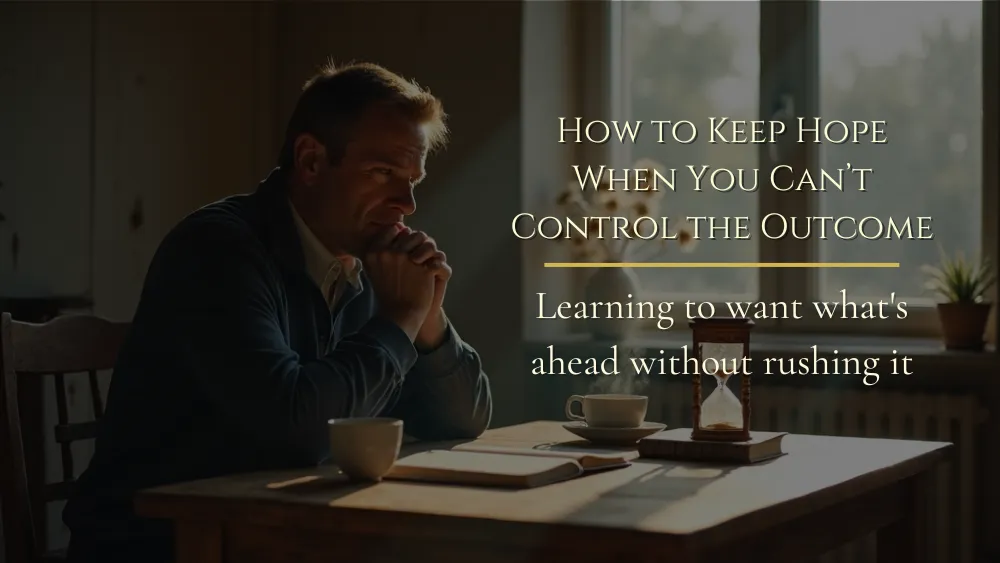
When you cannot control the outcome, hope can start to feel like pressure. You want clarity, progress, connection, healing, or change, but the future does not move just because you are ready for it. This chapter is about learning how to keep hope alive without rushing what still needs time.
There was a time when hope felt urgent.
I wanted answers quickly.
Change immediately.
Resolution now.
I believed that if something was good, it should arrive fast. And if it did not arrive fast, maybe it was not meant for me at all.
That way of thinking made hope feel heavy.
Not because hope was wrong.
Because I was trying to make hope carry certainty.
I wanted hope to prove itself before I trusted it.
But life has a way of teaching patience when impatience keeps breaking things.
Hope does not disappear when it slows down.
Sometimes it matures.
When Hope Learns to Slow Down
I still hope.
But not the way I used to.
Hope used to feel like reaching, gripping, checking, waiting, measuring, wondering, and trying to read signs before they were clear.
I wanted to know where things were going.
I wanted to know whether the future I pictured was possible.
I wanted to know if the waiting was worth it.
That kind of hope can become exhausting because it starts asking tomorrow to answer questions today was never meant to answer.
I am learning that hope does not always need to run ahead.
Sometimes hope needs to sit down.
Breathe.
Pray.
Wait.
Pay attention.
Not give up.
But not force the door open either.
That lesson connects naturally to How to Move Forward When the Future Feels Unclear, because there are seasons when the next step is visible before the outcome is.
The Difference Between Trust and Pressure
I have learned there is a subtle line between trusting the future and trying to force it.
Pressure rushes.
Trust waits.
Pressure demands signs.
Trust listens.
Pressure tries to control timing.
Trust respects that timing matters.
When I pushed too hard in the past — for clarity, for connection, for progress — I often confused effort with faith.
I mistook urgency for commitment.
I mistook intensity for sincerity.
I mistook motion for obedience.
And sometimes, I damaged things that needed time instead of force.
That is hard to admit.
Because forcing an outcome does not always look aggressive from the outside.
Sometimes it looks like overthinking.
Overexplaining.
Trying too hard.
Checking constantly.
Reaching again when silence may have been asking me to pause.
Trying to make something happen because waiting felt unbearable.
But trust does not need to panic to prove it is real.
Faith does not need to control the future to believe God is still present in it.
That truth connects to What Faith Teaches You About Letting Go of Control, because control often disguises itself as responsibility when fear is underneath it.
Choosing Restraint as an Act of Faith
Restraint does not mean giving up.
That is what I used to fear.
I thought if I stopped pushing, I was quitting.
If I stopped reaching, I was letting go too easily.
If I stopped trying to control the outcome, I was admitting it did not matter.
But restraint can be love.
Restraint can be wisdom.
Restraint can be faith.
It means refusing to rush what deserves care.
It means believing timing matters just as much as desire.
It means understanding that some doors open best when knocked on gently — or not at all until they are ready.
This kind of restraint is uncomfortable.
It leaves space for uncertainty.
It gives the future room to breathe.
It gives other people room to choose.
It gives God room to work without my hands constantly trying to rearrange the pieces.
And maybe most importantly, it protects what is fragile.
Including me.
Hope That Has Been Refined
Hope feels different now than it once did.
It does not shout.
It does not demand guarantees.
It does not panic when progress feels slow.
It stays.
This hope is quieter, slower, and more deliberate.
It is not rooted in outcomes the way it used to be.
It is rooted in belief.
Belief that God is not careless with timing.
Belief that delay is not always denial.
Belief that wanting something deeply does not mean I am supposed to force it into place.
Belief that tomorrow can still be good even if it does not arrive in the shape I expected.
That kind of hope has been refined by disappointment.
It has learned that not every open door is safe.
Not every delay is punishment.
Not every unanswered question is abandonment.
Not every slow season is wasted.
Sometimes hope grows stronger when it stops demanding proof every day.
When Waiting Feels Like Losing Control
Waiting is hard for me because waiting can feel like powerlessness.
It can feel like standing still while life keeps moving.
It can feel like watching something important remain just out of reach.
But I am learning that waiting is not always passive.
Sometimes waiting is active trust.
It is choosing not to sabotage peace because uncertainty feels uncomfortable.
It is choosing not to create chaos just so something happens.
It is choosing not to trade patience for temporary relief.
That matters because I know what urgency has cost me before.
Urgency has made me speak too quickly.
Reach too often.
Try too hard.
Hold too tightly.
It has made me confuse anxiety with love and pressure with faithfulness.
But hope does not need to become frantic to stay alive.
Sometimes the most faithful thing I can do is wait without trying to manipulate the ending.
Letting the Story Unfold Naturally
I do not need to force the ending.
The future does not need my urgency.
It needs my steadiness.
So I am learning to hope without gripping too tightly.
To want what is ahead without dragging it toward me before it is ready.
To trust that what is meant to come will arrive with clarity, not chaos.
That does not mean I stop caring.
It means I stop trying to control what care cannot control.
It means I stop treating every delay like rejection.
It means I stop assuming that if something matters, I must constantly prove it by pushing.
There are things in life that cannot be rushed without being harmed.
Healing is one of them.
Trust is one of them.
Love is one of them.
Faith is one of them.
The future is one of them.
That is why this chapter belongs in Tomorrow. It is not only about hope. It is about learning how to carry hope responsibly.
What Hope Looks Like From Here
From here, hope looks quieter.
It looks like prayer without panic.
Desire without demand.
Movement without force.
Patience without numbness.
Openness without desperation.
It looks like staying willing while refusing to be ruled by urgency.
It looks like believing tomorrow can still hold goodness, even if I do not get to control how it arrives.
That kind of hope is not weak.
It may be the strongest hope I have ever carried.
Because it does not need guarantees to remain alive.
It does not need control to stay faithful.
It does not need the outcome in its hands before it trusts the One who holds the story.
What This Chapter Taught Me
Hope becomes heavier when I try to make it control the outcome.
Pressure is not the same as faith.
Urgency is not the same as love.
Restraint is not the same as giving up.
I am learning that hope can be patient and still be real.
It can wait and still be alive.
It can want something deeply without forcing it.
The future does not need my panic.
It needs my faithfulness.
For now, hope is enough.
And patience is how I honor it.
Scripture Reflection
“Wait on the LORD: be of good courage, and he shall strengthen thine heart: wait, I say, on the LORD.”
— Psalm 27:14
This verse fits this chapter because it does not treat waiting like weakness.
It connects waiting with courage.
That matters to me.
Because sometimes waiting feels like doing nothing, when really it may be one of the hardest forms of trust.
I am learning to wait without surrendering hope.
To be strong without forcing the outcome.
To let God strengthen my heart while the story is still unfolding.
Continue the Story
These chapters continue the journey through uncertainty, patience, restraint, and learning how to trust tomorrow without forcing it:
-
How to Move Forward When the Future Feels Unclear
For learning to take the next step when the whole path is not visible yet. -
How Small Faithful Choices Shape Your Future
For understanding how the future is shaped by small, faithful decisions repeated over time. -
What Faith Teaches You About Letting Go of Control
For trusting God when control feels safer than surrender.
Move Through This Book