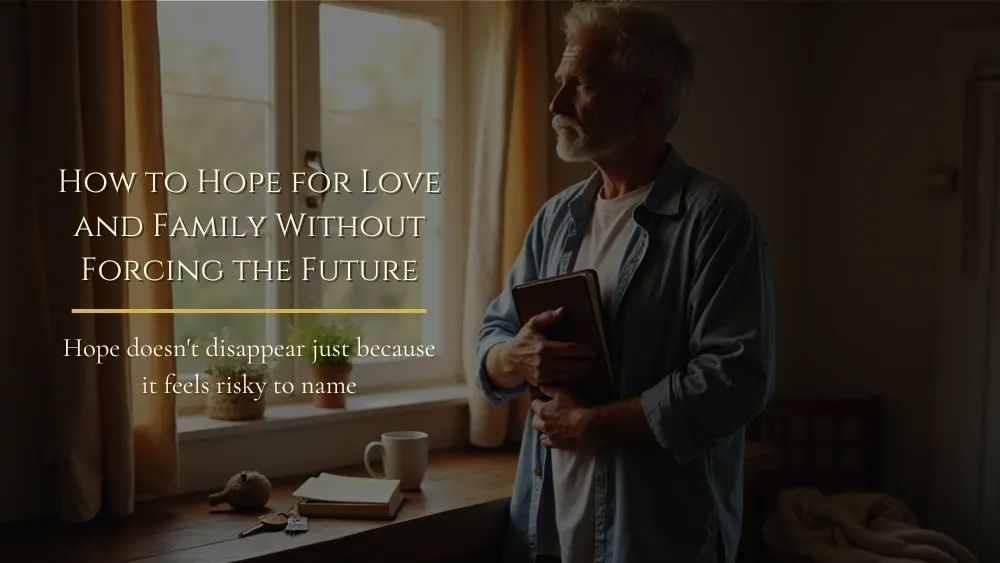
Hoping for love, family, and second chances can feel risky when the outcome is uncertain. Some desires are easy to talk about. Others feel too tender to name because naming them makes them feel exposed. This chapter is about carrying hope honestly without turning it into pressure, control, or a demand the future has to obey.
The Hope I Keep Guarded
There is a part of my future I rarely speak about openly.
Not because I do not want it.
Because I do.
That is what makes it feel fragile.
Naming it out loud makes it feel like something that could be dismissed, misunderstood, or lost before it ever has a chance to exist.
I hope my love life improves.
Dramatically.
That sentence feels heavier than it should.
Not because it is wrong to want love.
Not because I am ashamed of wanting partnership.
But because hope becomes vulnerable when it touches something that still matters deeply.
I can write about faith.
I can write about fatherhood.
I can write about healing, growth, and tomorrow.
But there are some hopes that still make me feel exposed.
Love is one of them.
Family is one of them.
Second chances are one of them.
And maybe that is why this chapter feels harder to write than some of the others.
Wanting More Without Forcing More
There is someone I care about.
And the situation is not simple.
There is honesty there.
There is care there.
There is connection there.
But there are also limits, boundaries, and realities I have to respect.
That matters.
Because wanting more does not give me permission to pressure someone into wanting the same thing.
Hope does not become love just because I feel it strongly.
Love has to be chosen freely.
Not convinced.
Not managed.
Not emotionally negotiated into existence.
That is a hard truth to live with when my heart sees possibility.
Because part of me wants to believe that if something feels meaningful enough, it should naturally become more. But life does not always move that cleanly. People carry their own wounds, beliefs, fears, histories, and limits. I do not get to decide someone else’s future just because I imagine myself in it.
That is where restraint becomes love.
Not the absence of desire.
The refusal to make my desire someone else’s burden.
This connects closely to How to Keep Hope When You Can’t Control the Outcome, because the hardest kind of hope is the kind that cannot demand proof, speed, or certainty before it chooses patience.
I can hope.
I can care.
I can remain honest.
But I cannot force.
And I do not want a future that had to be pressured into happening.
The Family Future I Still Imagine
There is another part of this hope that feels even harder to say.
I still imagine family.
Not in a careless way.
Not in a fantasy where everything becomes easy.
But quietly.
Carefully.
I imagine partnership.
Shared routines.
A home with warmth in it.
A future where love feels chosen, steady, and mutual.
And yes, there is still a small, quiet part of me that imagines another child.
One more chance.
One more life to help raise with the wisdom I did not always have before.
That is difficult to admit because I already have children I love deeply.
Wanting another child is not about replacing anything.
It is not about undoing the past.
It is not about pretending fatherhood can be restarted like a clean page.
It is about redemption.
It is about the ache of knowing there were moments I wish I had handled differently.
Times I was present, but not always whole.
Times I was loving, but still surviving.
Times I was trying, but still carrying wounds I did not fully understand.
That regret does not erase the love I gave.
But it does make me tender toward the future.
It makes me wonder what it would look like to father from a place of more healing, more patience, more wisdom, and more peace.
That longing connects naturally to What Children Remember About Their Parents, because fatherhood keeps teaching me that legacy is written in ordinary moments long before we know which ones will matter most.
I cannot rewrite every moment behind me.
But I can keep becoming the kind of man who would carry the next moment better.
Loving Without Demanding the Outcome
This is the tension I live in.
Wanting love without trying to change someone.
Hoping for more while respecting where things are.
Imagining a family future without insisting it has to happen.
Holding desire without gripping it so tightly that it becomes control.
That is not easy.
It asks a kind of maturity that does not always feel natural to me.
Because when something matters, I want to protect it.
When I see possibility, I want to make room for it.
When I love, I do not love lightly.
But I am learning that love cannot be protected by force.
It cannot be secured by pressure.
It cannot become healthy through fear.
If something real is going to grow, it has to grow freely.
That means I have to let the future breathe.
I have to let another person remain honest, even when their honesty does not match my hope.
I have to let my own desires exist without turning them into instructions for someone else.
That kind of restraint is painful sometimes.
But it is also necessary.
Because forced outcomes do not build love.
They break it.
Why I Do Not Say This Out Loud
I do not say this hope out loud often because it is deeply personal.
Because it touches my regrets.
Because it exposes my longing.
Because it admits I still believe in love, even after disappointment.
Because it reveals that there are parts of me still hoping for a future that feels tender, redemptive, and whole.
And because hoping for family — for partnership, for healing, for second chances — feels like standing unprotected in the open.
It is easier to talk about the lessons after they are over.
It is easier to write about wounds once they have a shape.
It is easier to sound wise about hope when the outcome no longer has access to your heart.
But this hope still does.
That is why I guard it.
Not because it is small.
Because it matters too much to handle carelessly.
That connects with How to Stay Open to the Future After Disappointment, because staying open does not mean being careless with your heart. Sometimes it means allowing hope to remain alive without exposing it to every opinion, fear, or assumption.
Some hopes need protection.
Not because they are weak.
Because they are sacred.
When Hope Feels Like Risk
Hope feels risky when the future involves another person.
It is one thing to hope for personal growth.
It is another thing to hope where someone else’s freedom matters.
That kind of hope cannot be managed alone.
It cannot be scheduled into existence.
It cannot be planned perfectly.
It involves trust, timing, consent, mutuality, healing, and choices that are not mine to control.
That is what makes it vulnerable.
I can want something deeply and still have to release the outcome.
I can believe something is possible and still accept that possibility is not a promise.
I can carry desire without demanding that God fulfill it the way I imagined.
That last part is hard.
Because Psalm 37:4 speaks about the desires of the heart, and sometimes I want that to mean every tender hope will arrive exactly as I picture it.
But I know faith is deeper than that.
God is not a machine for fulfilling fantasy.
He is a Father who knows the heart beneath the desire.
Sometimes He gives what we long for.
Sometimes He reshapes what we long for.
Sometimes He teaches us what the desire was really pointing toward all along.
Letting Hope Exist Quietly
I do not know how this part of my future will unfold.
I do not know if love will become more.
I do not know if family will look the way I imagine.
I do not know if another child is part of my story.
I do not know if this hope will be fulfilled, reshaped, or released.
But for now, I am allowing it to exist.
Quietly.
Honestly.
Without demands.
I am learning that hope does not have to be loud to be real.
It does not have to be announced to be meaningful.
It does not have to be defended in every conversation.
Some hopes are not meant to be shouted.
Some hopes are meant to be carried carefully.
Held with open hands.
Protected from pressure.
Offered to God without pretending surrender is easy.
That is what I am trying to do with this one.
Carry it carefully.
Love honestly.
Respect reality.
Trust God with the parts I cannot control.
And let tomorrow decide what it is ready to become.
What This Chapter Taught Me
Hoping for love and family does not make me weak.
It makes me honest.
But honesty still needs wisdom.
I can want more without forcing more.
I can hope for a future with someone while respecting their freedom.
I can imagine redemption without trying to use another person to repair my regrets.
I can carry desire carefully instead of turning it into pressure.
Some hopes are too tender to handle loudly.
That does not make them less real.
It only means they need to be held with care.
Scripture Reflection
“Delight thyself also in the LORD; and he shall give thee the desires of thine heart.”
— Psalm 37:4
This verse fits this chapter because it does not begin with desire.
It begins with delighting in the Lord.
That matters to me.
Because my desires are real, but they still need to be held in God’s presence. They need surrender. They need wisdom. They need patience. They need to be shaped by love instead of fear.
I can bring God the future I rarely say out loud.
I can trust Him with the tenderness of it.
And I can believe He understands the desire beneath the words, even when I do not know what tomorrow will do with it.
Continue the Story
These chapters continue the journey through hope, love, restraint, and the future I am learning to hold carefully:
-
How to Keep Hope When You Can’t Control the Outcome
For learning how to hold hope patiently without turning it into pressure. -
How Hope Returns After Heartbreak When You Stop Forcing It
For seeing how hope can come back after disappointment when it is no longer driven by control. -
What Children Remember About Their Parents
For reflecting on fatherhood, legacy, and the quiet redemption that can grow through ordinary presence.
Move Through This Book