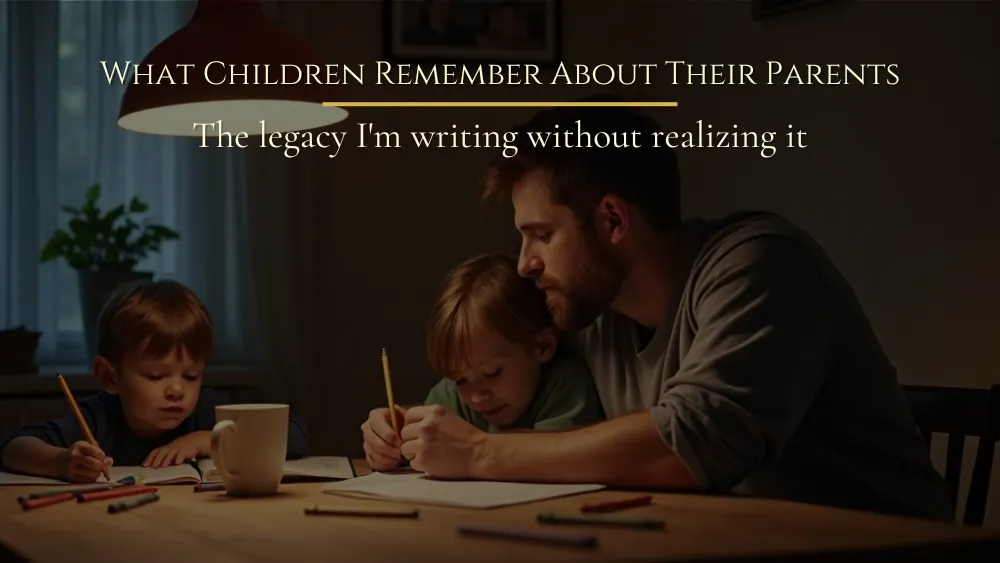
Thinking about the legacy you are leaving as a parent can feel both heavy and clarifying. One day, our children may remember us less by the words we said and more by the way we consistently showed up, handled pressure, practiced faith, and made them feel safe. This chapter is about learning that the future our children look back on is being written in ordinary moments today.
One day, my children will look back on me.
Not the version I imagine.
Not the version I defend when I feel misunderstood.
Not the version I hope they noticed.
The version they actually experienced.
Consistently.
Quietly.
Over time.
That realization is both heavy and clarifying.
Because fatherhood is not only about who I am trying to become right now. It is also about the version of me my children may carry with them later.
The Version of Me They Will Remember
My children will not remember every word I said.
They will not remember every rule I enforced.
They will not remember every explanation I gave, every correction I made, or every moment where I thought I was teaching something important.
But they may remember how the room felt when I walked into it.
They may remember whether my presence brought peace or tension.
They may remember whether I listened when they needed me.
They may remember whether I apologized when I was wrong.
They may remember whether love felt steady or conditional.
That is what humbles me.
Children do not only inherit what we intentionally teach.
They absorb what we repeatedly live.
That weight connects closely to How Fatherhood Changes You, where I first reflected on how responsibility, presence, and love began reshaping the man I was becoming.
Fatherhood changed me because it made the future personal.
It made tomorrow look like faces.
Names.
Small hands.
Questions.
Memories forming before anyone realizes they are becoming memories.
Legacy Is Written in Ordinary Days
Legacy is not built only in grand speeches or perfect seasons.
It is shaped in mornings that feel rushed.
In evenings when I am tired but still listening.
In the way I speak about their mother, about work, about God, about myself.
It is written in what I model when no one is applauding.
Especially when I am frustrated.
Uncertain.
Worn thin.
Running low on patience.
The future version of their memories is being formed now, in the unnoticed spaces of everyday life.
That makes ordinary days feel less ordinary.
A car ride can become a memory.
A calm answer can become safety.
A repeated apology can become trust.
A small act of attention can become evidence that they mattered.
I used to think legacy sounded like something older people talked about near the end of life.
Now I understand it begins much earlier.
Legacy is not only what people say after you are gone.
It is what your presence teaches while you are still here.
What I Hope They Saw
I hope my children remember a father who tried.
Not one who had all the answers.
One who kept learning.
Not one who never failed.
One who took responsibility when he did.
Not one who was perfect.
One who was present.
That kind of presence continues in How to Be a More Present Father, where I reflect on why ordinary attention can matter more than having all the answers.
I hope they saw consistency more than intensity.
Integrity more than image.
Effort more than excuses.
I hope they remember that I cared enough to keep growing.
That I did not settle for being shaped only by what happened to me.
That I tried to become safer, gentler, wiser, and more patient with time.
I hope they saw a man who loved them deeply, even when he was still learning how to express that love well.
Because love is not only felt by the parent.
It has to be experienced by the child.
That difference matters.
I may know I love them.
But the question is whether they feel loved in the way I show up.
What Children Remember Most
Children remember patterns.
They remember tone.
They remember whether affection came freely or had to be earned.
They remember whether mistakes were met with guidance or shame.
They remember whether home felt like a place to breathe.
They remember whether their questions were welcomed or brushed aside.
They remember whether they could be honest without fearing rejection.
And they remember far more than we think they do.
That does not mean every parent has to live terrified of making mistakes.
That would be impossible.
But it does mean fatherhood asks for awareness.
The goal is not perfection.
The goal is repair.
The goal is presence.
The goal is becoming the kind of person whose children can look back and say, “He was human, but he kept showing up.”
I think that matters more than appearing impressive.
Children do not need a flawless father.
They need a faithful one.
They need someone who returns.
Someone who listens.
Someone who learns.
Someone who loves with enough steadiness that they do not have to question whether they belong.
Teaching Them Without Lecturing
Some lessons do not come from what we say.
They come from what we tolerate.
From how we apologize.
From how we recover when things go wrong.
From what we do when we are angry.
From how we speak when life disappoints us.
From what we reach for when we are stressed.
From whether faith is something we perform or something we live.
I am realizing that the most powerful teaching moments rarely feel like lessons at all.
They feel like choices.
Quiet choices.
Repeated choices.
Choices noticed later.
That truth connects to What Children Learn From Their Father Without Being Taught, because children often learn from the atmosphere we create before they understand the words we use.
They learn how to handle frustration by watching how I handle mine.
They learn how to treat people by watching how I speak when I am tired.
They learn how to value themselves by watching whether I make time for them.
They learn what faith looks like by watching whether I trust God when life feels uncertain.
They learn from the life beneath the lesson.
That is both sobering and hopeful.
Sobering because I know I am always teaching something.
Hopeful because it means small faithful choices matter more than I sometimes realize.
The Weight of Tone
One thing I think about more now is tone.
Not only what I say.
How I say it.
A father’s tone can either build safety or quietly weaken it.
A child can hear love in correction.
But a child can also hear frustration, contempt, impatience, or distance.
Sometimes the words may be technically right, but the spirit behind them still hurts.
That is hard to admit.
Because pressure changes tone.
Exhaustion changes tone.
Stress changes tone.
Old wounds can change tone before I realize they have entered the room.
That is why patience matters so much in fatherhood.
Not the fake kind of patience that pretends nothing bothers me.
The real kind that slows down before speaking.
The kind that remembers the child in front of me is not responsible for the pressure I carried into the moment.
That lesson connects naturally to How Fatherhood Teaches Patience Through Everyday Moments, because patience is not only learned in big parenting crises. It is practiced in the repeated interruptions, questions, needs, mistakes, and ordinary tensions of daily life.
A calm tone can become a form of love.
A gentle answer can become a memory.
A restrained reaction can become safety.
That does not mean I always get it right.
But it means I want to notice quicker.
Repair sooner.
Choose better.
Becoming the Man They’ll Describe Someday
I cannot control the future version of their story.
But I can influence the man they may describe when someone asks, “What was your dad like?”
That answer is being shaped right now.
In patience practiced.
In values lived.
In love shown without conditions.
In the way I keep showing up when life is inconvenient.
In the way I respond after failure.
In the way I make room for them while still becoming myself.
This is where fatherhood reaches into Tomorrow.
Because the future is not only something I am walking toward.
It is something I am helping shape.
My children’s memories are being written while I am busy living ordinary days.
That is why How to Face the Future When It Feels Uncertain belongs close to this chapter. The future can feel unclear, but fatherhood reminds me that some of tomorrow is shaped by the faithfulness I choose today.
I cannot write every page of their lives.
I should not try to.
But I can be careful with the pages where my name appears.
I can be honest.
Steady.
Present.
Humble enough to grow.
Strong enough to protect.
Soft enough to listen.
That is the kind of father I want them to remember.
Choosing Today for the Sake of Tomorrow
The future does not begin someday.
It begins now.
In the way I live today.
In the way I answer when they interrupt me.
In the way I look up from my phone.
In the way I handle inconvenience.
In the way I keep my word.
In the way I pray.
In the way I rebuild after getting something wrong.
I used to think tomorrow was far away.
Now I understand tomorrow is being formed in today’s repeated choices.
Every ordinary day is quietly becoming part of their memory.
That does not make fatherhood feel easier.
But it does make it clearer.
I do not have to become perfect overnight.
I have to become faithful over time.
I have to keep choosing the kind of presence I want them to remember.
I have to keep letting God shape the parts of me that still react too quickly, carry too much pressure, or confuse providing with connecting.
And when I fail, I have to return with humility.
Because repair is part of legacy too.
Children do not only remember that something went wrong.
They remember whether love came back into the room afterward.
Faith They Can See
Psalm 78:4 fits this chapter because it reminds me that faith is not only something I carry privately.
It is something I pass forward.
Not by forcing my children into a performance.
Not by turning every moment into a sermon.
But by letting them see what faith looks like in a real life.
A life with pressure.
Questions.
Work.
Weariness.
Hope.
Mistakes.
Repair.
Prayer.
Trust.
If I want my children to remember faith, I cannot only talk about God.
I have to live like God is present in the ordinary.
I have to let them see me trust Him when tomorrow feels uncertain.
Let them see me apologize when conviction finds me.
Let them see me keep going when life feels heavy.
Let them see that faith is not an escape from responsibility.
It is part of how I carry responsibility.
That is the kind of legacy I want to leave.
Not a perfect religious image.
A lived faith.
A faith humble enough to admit weakness.
Steady enough to keep showing up.
Honest enough to say, “I am still learning too.”
What This Chapter Taught Me
Legacy is shaped less by what I say and more by what my children consistently experience.
Ordinary days are not insignificant.
They are where trust, safety, faith, and values are quietly written.
The future my children may remember is being formed by the choices I make today.
I do not need to be perfect to leave something good behind.
But I do need to be present.
I need to be willing to repair.
I need to be honest about the version of me they actually experience, not only the version I hope they understand.
Fatherhood keeps teaching me that love is not only intention.
Love is atmosphere.
Love is consistency.
Love is humility.
Love is showing up again and again until safety becomes something my children do not have to question.
Scripture Reflection
“We will not hide them from their children, shewing to the generation to come the praises of the LORD, and his strength, and his wonderful works that he hath done.”
— Psalm 78:4
This verse reminds me that legacy is not only emotional.
It is spiritual.
What I pass to my children is not only memory, habit, tone, and presence.
It is also the story of God’s faithfulness.
I want them to remember a father who pointed them toward hope.
Not perfectly.
But honestly.
Not loudly.
But faithfully.
Continue the Story
These chapters continue the journey through fatherhood, presence, future, and the quiet responsibility of becoming someone my children can remember with safety and love:
-
How Fatherhood Changes You
How fatherhood first reshaped responsibility, fear, and the quiet decision to keep showing up. -
How to Be a More Present Father
A reflection on why ordinary presence matters more than perfection. -
What Children Learn From Their Father Without Being Taught
How children absorb values, habits, tone, and faith through what they witness every day.
Move Through This Book