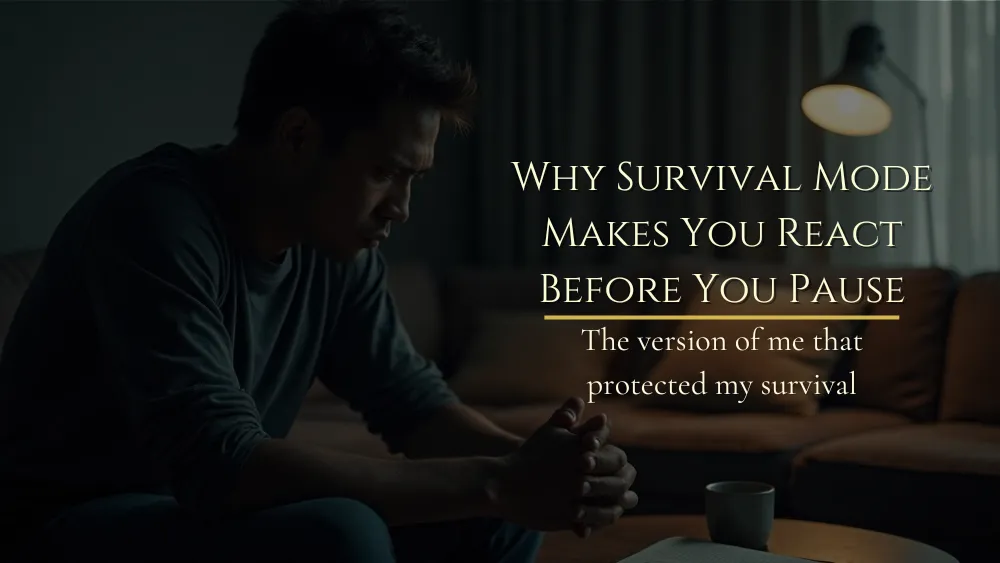
Survival mode can make you react before you pause, especially when love, security, or stability feels threatened. If you have ever responded too quickly, spoken from fear, or felt your body move faster than your wisdom, this chapter is about the version of me that once protected my survival—and why I am learning he cannot lead forever.
There is a version of me that knows how to survive.
He reacts quickly when something essential feels threatened.
Love.
Security.
Stability.
Belonging.
He does not pause to assess nuance or intent. He does not always ask whether the present moment is actually dangerous. He responds to danger the way he learned to respond long ago: immediately, forcefully, and without waiting for permission.
For a long time, that version of me helped me survive.
But survival instincts do not always know when the danger has passed.
The Version of Me That Learned to React
I did not become reactive because I wanted to be difficult.
I became reactive because there were seasons when waiting felt costly.
When silence felt unsafe.
When uncertainty felt like warning.
When love, stability, food, shelter, safety, or belonging could not be assumed.
In those seasons, quick response felt like protection. If something felt wrong, I moved. If something felt threatened, I defended. If something felt like loss, I grabbed tighter. If something felt unstable, I tried to regain control before everything collapsed.
That kind of reaction can look irrational from the outside.
But inside, it can feel necessary.
It can feel like the only way to keep from falling back into something you once barely survived.
That is why I do not hate this version of myself.
I understand him.
He learned to act quickly because life did not always give him time to feel safe.
That survival pattern connects closely to How Childhood Emotional Neglect Teaches You to Survive, because some reactions do not begin as personality traits. They begin as adaptations to a world that did not feel safe enough to trust.
When Love Feels Like Survival
Love, for me, has not always felt optional.
It has often felt necessary.
Not because I wanted to place too much weight on another person, but because love represented something deeper than companionship. It represented safety. Belonging. Reassurance. Proof that I mattered. Proof that I had not been left behind again.
So when love felt uncertain, distant, unavailable, or slipping away, my reaction was not always measured.
It was desperate.
Fear-driven.
Urgent.
I responded as if something vital was being taken from me because emotionally, that is what it felt like.
That is hard to admit because I know love should not have to carry the full weight of my survival. Real love cannot grow well when it is treated like the last safe place on earth. It needs trust. Breath. Patience. Room to move without every silence becoming a threat.
But old wounds do not always understand that.
Old wounds hear distance and call it abandonment.
They hear uncertainty and call it danger.
They hear pause and call it rejection.
That is where reaction begins.
Not always in anger.
Sometimes in fear.
Sometimes what looks like anger on the outside is fear trying to protect something it does not know how to lose.
That truth does not excuse every reaction.
But it helps me understand where the reaction begins.
And understanding the beginning is part of learning how to choose a different ending.
When Stability Feels Threatened
This pattern does not only show up in relationships.
It appears whenever stability feels at risk.
If income drops.
If expenses rise.
If control feels like it is slipping away.
If the future feels uncertain.
My body can respond before my mind slows the moment down. Anxiety becomes urgency. Urgency becomes reaction. And reaction can come out sideways: frustration, sharp words, emotional volatility, or the need to fix everything immediately.
What I am learning is that my reactions are rarely only about the present moment.
They are often about the fear of falling back into instability I once barely survived.
That matters because it gives me a different way to understand myself. I am not trying to diagnose myself or turn every reaction into a clinical explanation. I am simply learning to notice the pattern.
When something feels unstable now, it can awaken memories of when stability was not guaranteed then.
That is why Why My Body Reacted Before I Understood the Danger belongs close to this chapter. Sometimes the body reacts before the mind has language, especially when the present moment feels similar to something old.
The body remembers instability.
The body remembers fear.
The body remembers what it cost to be unprotected.
And sometimes, long after life has changed, the body still sounds alarms as if nothing has.
Gratitude Without Permission to Stay
I do not hate the Reactionary Survivor.
I respect him.
He stepped in when no one else did.
He learned to act fast because waiting once came at a cost.
He believed hesitation meant loss.
He believed silence meant danger.
He believed urgency was the same thing as safety.
There is grief in recognizing that.
Because this version of me was not born from arrogance. He was born from necessity. He was shaped by seasons where reaction felt like protection and calm felt like risk.
But what once protected me can now harm the very things I want to preserve.
Reaction interrupts connection.
Reaction damages trust.
Reaction makes others feel unsafe, even when my intention is survival.
Reaction can make me sound harsher than I mean to sound.
Reaction can make me defend myself when what I really need is to listen.
Reaction can make love feel like a battlefield when what I want most is peace.
That is the painful truth of becoming.
Sometimes I have to thank an old version of myself for helping me survive, while also telling him he cannot keep leading my life.
I can be grateful for the version of me that survived without giving him permission to stay in control.
That is not rejection.
It is maturity.
Learning to Interrupt the Reaction
The hardest part of becoming is not always change.
Sometimes it is discernment.
Knowing when an old instinct no longer serves the present reality.
My survival is not as fragile as it once was. But my nervous system does not always know that yet. It still sounds alarms when love feels uncertain, when finances feel unstable, when control feels limited, or when someone’s tone reminds me of something older than the moment itself.
So now, the work is not pretending I never react.
The work is interrupting the reaction sooner.
Pausing long enough to ask:
Is this actual danger, or does this just feel familiar?
That question has become important to me.
Because familiar pain can disguise itself as present danger.
A delayed response can feel like abandonment.
A disagreement can feel like rejection.
A financial setback can feel like collapse.
A quiet room can feel like warning.
But feelings, while real, are not always accurate instructions.
They deserve attention.
They do not always deserve control.
That is why How to Pause Before Reacting continues to matter in this part of the Becoming book. The pause is not just about being polite or calm. Sometimes the pause is where I separate old fear from present truth.
When the Pause Feels Unsafe
Pausing sounds simple until the body believes something important is at risk.
When I feel threatened, slowing down can feel dangerous. It can feel like giving up control. It can feel like letting someone else decide the outcome. It can feel like standing still while something I love is slipping away.
That is why I have often rushed.
Rushed to explain.
Rushed to defend.
Rushed to fix.
Rushed to prove.
Rushed to stop the loss before it became final.
But rushing has not always protected what I loved.
Sometimes rushing became the thing that damaged it.
That is one of the hardest lessons I am still learning.
A reaction may feel protective in the moment, but protection is not the same as wisdom.
Sometimes wisdom waits.
Sometimes wisdom breathes.
Sometimes wisdom chooses silence long enough for the truth to become clearer.
Sometimes wisdom does not answer from the first wave of fear.
That kind of restraint connects with How to Stay Present When You Want to Escape, because staying present is not only about resisting distraction. Sometimes it is about staying in the discomfort long enough to not become ruled by it.
Becoming Without Erasing My Past
This chapter is not about rejecting who I was.
It is about releasing who I no longer need to be.
The Reactionary Survivor kept me alive.
But he does not get to lead anymore.
He can explain where I came from.
He can remind me what I survived.
He can help me recognize why certain things still feel threatening.
But he cannot be the voice that chooses my words.
He cannot be the one deciding how I love.
He cannot be the one handling conflict.
He cannot keep treating every uncertain moment like proof that everything is about to fall apart.
That is where responsibility enters the story.
Not shame.
Responsibility.
I am responsible for learning my patterns.
Responsible for noticing when urgency is rising.
Responsible for naming fear before it becomes harm.
Responsible for choosing restraint when reaction wants to take over.
Responsible for becoming safer to love, safer to disagree with, and safer to be near when life feels uncertain.
That does not happen all at once.
But it can happen one pause at a time.
Patience as Understanding
Scripture does not shame me for having emotions.
It invites me into patience.
“Whoever is patient has great understanding, but one who is quick-tempered displays folly.”
— Proverbs 14:29
That verse meets this chapter directly.
Patience is not weakness.
It is understanding.
It is the ability to slow down long enough to see more than the first alarm. It is the maturity to recognize that every feeling does not need to become an immediate response. It is the humility to admit that my first reaction may not always be my truest one.
Quick temper does not always mean I do not care.
Sometimes it means I care with fear still attached.
But care shaped by fear can still wound.
That is why patience matters.
Patience gives love room to breathe.
Patience gives truth room to surface.
Patience gives God room to work in the space I usually try to control.
What This Chapter Taught Me
Survival mode can make reaction feel necessary, especially when love, security, or stability feels threatened.
The Reactionary Survivor was not evil. He was protective.
But what protected me in unstable seasons can harm me in healthier ones.
My reactions are often less about the present moment and more about old fear being awakened.
Pausing is not weakness. It is discernment.
Patience is not passivity. It is understanding.
And becoming means learning how to thank the part of me that survived while no longer letting that part lead every response.
I am learning that survival does not require urgency the way it once did.
Love does not grow well where reaction is always waiting to strike.
Peace does not deepen where fear keeps reaching for control.
So I am practicing something new.
Not perfection.
Not emotional numbness.
Not pretending the alarms never sound.
Just awareness.
A breath.
A pause.
A slower answer.
A different choice.
This is part of becoming.
Not by force.
But by learning that I am safer now than my reactions sometimes believe.
Continue the Story
These chapters continue the journey through reaction, heartbreak, restraint, and learning how to respond from healing instead of fear:
-
Why Heartbreak Makes You React Before You Can Pause
A reflection on heartbreak, restraint, and the place where healing still feels unfinished. -
How Restraint Changed the Way I Experience Conflict and Connection
A reflection on how restraint creates calm where urgency once lived. -
How Grief Reveals the Way You Respond to Loss
A reflection on expected loss, sudden loss, heartbreak, and the patterns grief exposes.
Move Through This Book