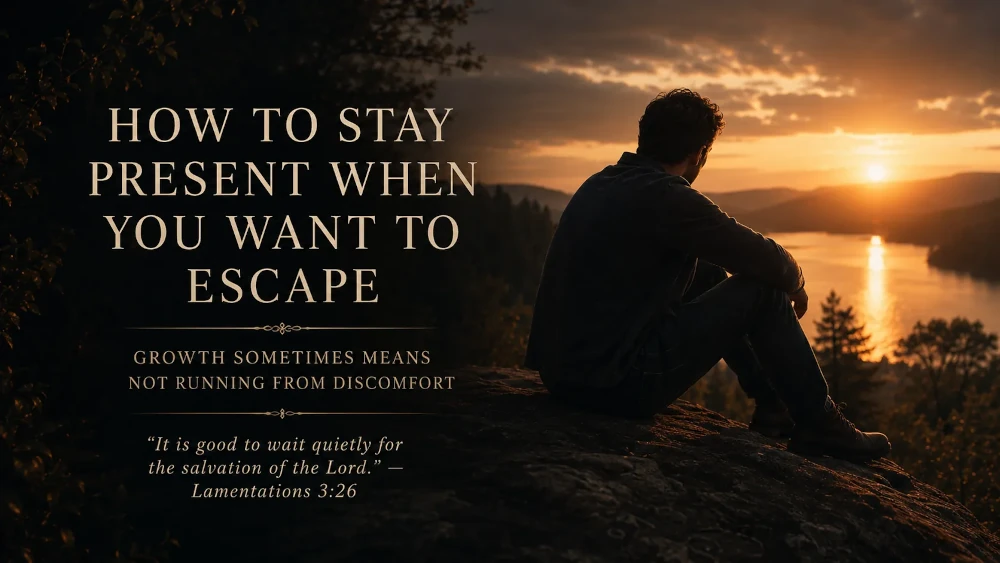
Learning to stay present when you want to escape is hard, especially after loss, disappointment, or emotional pain. If you have ever felt the urge to distract yourself, stay busy, or move too quickly so you do not have to feel what hurts, this chapter is about the quiet courage of staying.
Growth does not always happen through motion.
Sometimes it happens through presence.
When the Urge to Escape Gets Loud
After loss, my instinct is not always to grieve.
Sometimes it is to escape.
To distract myself.
To stay busy.
To move forward too quickly so I do not have to sit with what hurts.
Presence can feel dangerous when emotions are unresolved. Stillness gives them room to speak. And when I already feel overwhelmed, the last thing I want is more room for the ache to rise.
So I have learned many ways not to be fully here.
I can throw myself into productivity.
I can focus on what needs fixing.
I can keep my mind crowded enough that my heart never gets a full sentence.
From the outside, that can look like strength.
But often it is avoidance.
That is part of what I explored in Why Personal Growth Can Feel Like Loss, because becoming does not always feel like gaining something. Sometimes it feels like facing what is gone without rushing to replace it.
What Escape Really Looks Like
Escape is not always dramatic.
Sometimes it looks like staying constantly busy.
Sometimes it looks like scrolling, overthinking, explaining, or trying to solve a feeling that really needs to be felt.
Sometimes it looks like refusing silence because silence feels too revealing.
And sometimes it looks like trying to outrun discomfort with progress.
I know that pattern because I have lived it.
When something hurts, I do not always want to stop and listen. I want to move. I want to do something. I want to regain control by creating motion.
But motion is not always healing.
Sometimes motion is just a more acceptable form of running.
That is difficult to admit because productivity can feel noble. It can make avoidance look disciplined. It can make restlessness look purposeful.
But if I am honest, some of the times I have looked most “together” on the outside were the times I was least willing to be still long enough to admit what was happening inside me.
Sometimes the urge to keep moving is not strength. Sometimes it is fear looking for somewhere to hide.
Presence Is Not Passivity
Staying present does not mean doing nothing.
It means resisting the urge to outrun discomfort with productivity, noise, or explanation.
It means allowing a moment to be exactly what it is before trying to improve it.
That is harder than it sounds.
Presence requires effort.
Not the effort of performance.
The effort of attention.
Attention to what I am feeling.
Attention to what I am avoiding.
Attention to what remains even after something meaningful is gone.
Attention to what God may be trying to show me in the very place I keep trying to leave.
There is a kind of maturity in that.
Not because presence feels powerful.
But because it asks me to stop reaching for quick relief and start telling the truth.
That connects naturally to How to Pause Before Reacting, because both chapters live in the space where growth begins to look less like urgency and more like restraint.
Staying With Discomfort Long Enough to Learn From It
There is a quiet responsibility that comes with being present.
Not just to others.
To myself.
To show up honestly instead of numbing out.
To stay when it would be easier to mentally leave.
To let pain speak without letting it take over.
I am realizing that responsibility is not always about fixing problems. Sometimes it is about holding space without resolution.
That kind of responsibility does not earn praise.
It just shapes character.
Because when I stop escaping, I start noticing things.
I notice what I fear.
I notice what I miss.
I notice which thoughts keep circling back.
I notice the places where I still want immediate relief instead of honest healing.
And I notice how often I confuse discomfort with danger.
Not every uncomfortable moment is harming me.
Some uncomfortable moments are simply revealing me.
They show me where I am still fragile.
Where I am still impatient.
Where I am still tempted to believe that if I cannot solve something quickly, I should not have to feel it deeply.
But growth has a way of slowing me down until I face what motion helped me avoid.
Faith Without Forward Motion
Faith has taught me that not every season requires momentum.
Some require endurance.
Some require restraint.
Some require trust without visible progress.
That is difficult for me because I like movement. I like signs. I like knowing something is happening. I like feeling as though I am going somewhere.
But God does not always work at the speed of my comfort.
Sometimes He asks me to be still before He asks me to move.
Sometimes He asks me to stay present long enough to learn that His presence is not dependent on visible change.
“It is good to wait quietly for the salvation of the Lord.”
— Lamentations 3:26
That verse meets this chapter gently because it does not glorify passivity. It honors quiet trust.
It reminds me that waiting is not always wasted.
Stillness is not always stagnation.
Sometimes stillness is submission to timing.
Sometimes it is faith refusing to create artificial motion just to feel in control.
Becoming Through Staying
This chapter does not end with clarity or closure.
It ends with commitment.
The commitment to stay present, even when the urge to escape is strong.
The commitment to let discomfort be honest instead of immediately trying to make it disappear.
The commitment to trust that growth sometimes happens through staying, not only through striving.
I am learning that becoming is not only about who I am becoming next.
It is also about who I choose to remain as right now.
Will I be honest?
Will I be present?
Will I stay with myself long enough to hear what my heart is carrying?
Will I let God meet me in the still place I keep trying to outrun?
And sometimes, staying is the bravest thing I can do.
Not dramatic staying.
Not impressive staying.
Just quiet, faithful presence.
The kind that does not always look like progress from the outside, but still changes me from the inside.
What This Chapter Taught Me
Escaping discomfort can look productive, but it is not always healing.
Staying present does not mean doing nothing; it means giving honest attention to what is happening inside me.
Not every uncomfortable feeling is a sign that something is wrong. Sometimes it is a sign that something needs to be faced.
Faith does not always require forward motion. Sometimes it requires quiet endurance.
Stillness is not always stagnation. Sometimes it is trust.
And sometimes, staying is the first real sign that growth is happening.
Continue the Story
These chapters continue the journey through slow growth, discomfort, restraint, and learning how to stay honest in the becoming process:
- Why Personal Growth Can Feel Like Loss
A reflection on the grief that can accompany becoming and the faith required to trust God when letting go hurts. - How to Pause Before Reacting
A reflection on urgency, restraint, and learning to slow down before old instincts speak first. - How to Know You’re Making Progress in Personal Growth
A reflection on quiet progress and learning to recognize growth even when it does not feel dramatic.
Move Through This Book