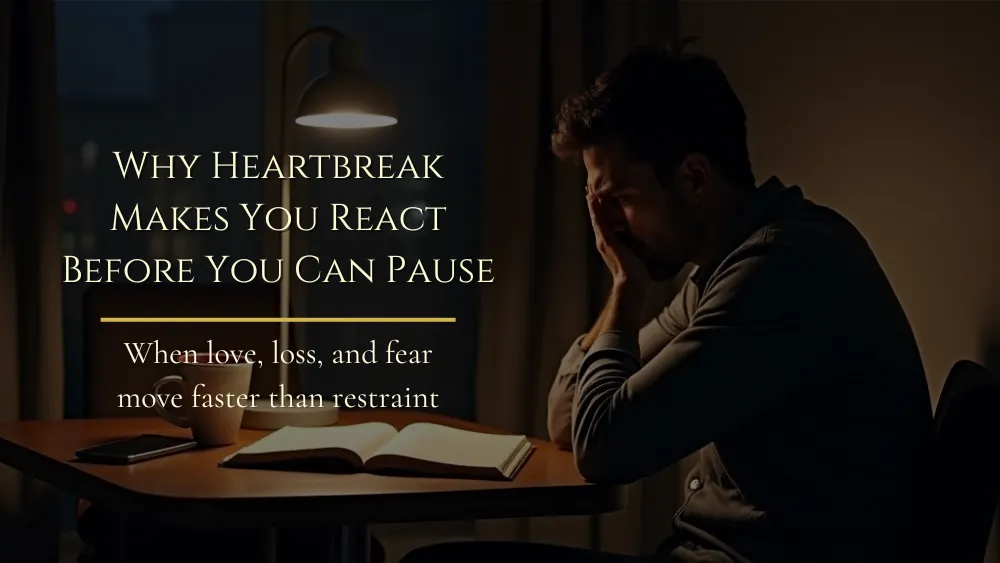
Heartbreak can make you react before you can pause, especially when love feels tied to safety, worth, and belonging. If you have ever responded from pain before clarity had time to arrive, this chapter is about the one emotion that still overwhelms my restraint—and what it is teaching me about healing.
There is one emotion I still struggle to sit with.
Not anger.
Not sadness.
Not fear.
Not frustration.
Heartbreak.
Every other emotion gives me at least a little space. Heartbreak does not. It arrives too fast, too full, and too personal. It does not simply hurt. It reaches into the places where love, hope, identity, and survival have become tangled together.
That is where I still have work to do.
When Heartbreak Arrives Too Fast
Heartbreak does not feel like ordinary sadness to me.
Sadness gives me room to breathe.
Disappointment gives me time to think.
Anger, even when it rises quickly, usually gives me something I can identify and manage.
But heartbreak is different.
Heartbreak feels like the ground moving beneath me before I can steady myself. It feels like something important being pulled away before I have time to understand what is happening. It feels like loss, rejection, fear, grief, and panic all arriving in the same breath.
That is why heartbreak has been harder for me to handle than almost anything else.
It does not wait politely for wisdom.
It does not ask if restraint is ready.
It does not slow down so I can respond from the healed version of myself.
It comes fast.
And when it comes from romantic love, especially love I had invested hope into, it reaches something deep in me.
Something old.
Something unfinished.
That connects closely to Why Survival Mode Makes You React Before You Pause, because heartbreak can make my body respond as if love is not just ending, but safety is being taken away.
When I Lost Her
Losing The Sister did not just hurt.
It destabilized me.
I was not only grieving the loss of a person. I was grieving what she represented to me: safety, hope, connection, belonging, and the belief that something good had finally found me.
That is a heavy thing to place inside one relationship.
I can see that now.
At the time, I did not see it clearly. I only knew that the loss felt unbearable. When the connection began slipping away, my response was not thoughtful or measured.
It was immediate.
Emotional.
Too much.
I reacted from pain instead of clarity.
From fear instead of restraint.
From the part of me that believed if I could say the right thing, explain enough, push hard enough, or make the pain visible enough, maybe I could stop the ending from becoming final.
But that is not how love works.
And that is not how healing works.
Reaction may feel like movement, but it does not always move anything toward repair.
Sometimes it only spreads the pain further.
I was not responding only to the moment. I was responding to what the loss seemed to say about me.
That is the part I have had to face honestly.
Losing her hurt.
But what overwhelmed me most was not only her absence.
It was the meaning my heart attached to it.
Why Heartbreak Hits Me Differently
Heartbreak does not feel like sadness to me.
It feels like loss of ground.
When love is involved, especially love I have hoped for, prayed over, imagined, and made emotional room for, my nervous system reacts as if something essential is being taken away.
Not just affection.
Belonging.
Direction.
Future.
Worth.
A sense that maybe I was finally chosen in a way I had been waiting for longer than I realized.
That is why restraint fails here when it can hold in other places.
I can be patient in responsibilities.
I can be steady with work.
I can handle pressure, disappointment, and exhaustion better than I used to.
But heartbreak touches the place where love and survival still speak too closely together.
It bypasses patience.
It outruns self-control.
It triggers the part of me that believes survival depends on being chosen.
That is a painful thing to admit, but it is true.
And it connects to How Grief Reveals the Way You Respond to Loss, because heartbreak is not just another feeling for me. It is one of the clearest places where loss reveals the patterns I still need to understand.
Reaction as a Defense
When I reacted after losing her, it was not because I wanted to cause harm.
It was because I wanted the pain to stop.
That does not excuse it.
But it explains the emotional movement underneath it.
Reaction felt like regaining control.
Like protecting what little dignity I thought I had left.
Like proving the loss mattered.
Like refusing to disappear quietly while my heart was breaking loudly.
But control gained through reaction is temporary.
The damage it causes can last much longer than the relief it brings.
That is one of the hard lessons heartbreak has taught me.
Pain wants immediate expression.
Healing asks for honest restraint.
Pain says, “Make them understand.”
Healing says, “Understand yourself first.”
Pain says, “Defend what this meant.”
Healing says, “Do not let the meaning of this moment decide your worth.”
Those are not easy lessons when the heart is hurting.
They are especially hard when heartbreak feels like rejection, and rejection feels like erasure.
That is why How to Pause Before Reacting belongs close to this chapter. The pause is not just about avoiding conflict. Sometimes the pause is the only space where I can separate what happened from what my fear says it means.
What the Loss Seemed to Mean
Looking back, I can see it more clearly now.
I was not only reacting to who she was in that moment.
I was reacting to what the loss seemed to mean about me.
That I was not enough.
That I was too much.
That I had misread the connection.
That the future I hoped for had disappeared before it fully arrived.
That love had come close enough to awaken hope, but not close enough to stay.
Those thoughts were not all true.
But heartbreak does not always care about accuracy at first.
It cares about impact.
And the impact was deep.
There was a version of me that believed losing her confirmed something old. Something painful. Something I have spent years trying to unlearn.
That is where heartbreak becomes dangerous for me.
Not because feeling heartbreak is wrong.
But because heartbreak can turn old wounds into present conclusions if I do not slow down long enough to question them.
Heartbreak does not always tell the truth first. Sometimes it tells the wound’s version of the story.
That line matters to me.
Because when I let the wound narrate the loss, I become more reactive, more desperate, and less able to see clearly.
Taking Note, Not Hiding
This chapter is not written to excuse my behavior.
It is written to understand it.
There is a difference.
Excuses try to remove responsibility.
Understanding helps me carry responsibility with honesty.
Heartbreak exposes where my healing is still unfinished. It shows me where love and worth are still too closely tied. It shows me where rejection can feel like erasure. It shows me where fear still speaks louder than wisdom.
Naming that does not undo the past.
It does not erase words I wish I had not said.
It does not make every reaction acceptable.
But it does help me stop repeating the pattern blindly.
That connects naturally to Why Old Patterns Still Show Up After Growth Begins, because growth does not mean every old reaction disappears immediately. Sometimes growth means I recognize the pattern sooner, tell the truth faster, and stop pretending I did not see it.
That is what I am trying to do here.
Tell the truth.
Not to punish myself.
Not to reopen what is already gone.
But to learn.
Because the version of me that reacts from heartbreak is still trying to protect something.
And if I do not understand what he is protecting, he will keep reaching for control every time love feels uncertain.
Learning to Stay With the Pain
I am learning that sitting with heartbreak does not mean denying it.
It does not mean minimizing it.
It does not mean pretending the loss did not matter.
It means allowing the pain to exist without letting it decide my actions.
That is difficult because heartbreak demands movement.
It wants a message.
An explanation.
A defense.
A final word.
A way to regain control.
But sometimes the most faithful thing I can do is stay still long enough to feel what is true without turning pain into a weapon.
That is not weakness.
That is maturity.
And it is slow.
It is uncomfortable.
I am not done with it.
There are still moments where heartbreak rises faster than wisdom. Moments where I feel the urge to explain more than I should. Moments where silence feels like losing twice. Moments where restraint feels less like peace and more like pain with nowhere to go.
That is why How to Stay Present When You Want to Escape matters in this part of the journey. Sitting with heartbreak is one of the hardest forms of staying present because every part of me wants to run, react, or reach for relief.
But healing asks me to stay.
Not with the person who left.
With myself.
With the ache.
With the truth.
With God.
Becoming Safer With Heartbreak
One of the most honest goals I have now is becoming safer with heartbreak.
Safer to myself.
Safer to others.
Safer in the way I respond when love does not go how I hoped.
That matters because heartbreak may explain why I react, but it cannot be allowed to control how I treat people.
Pain deserves compassion.
It does not deserve permission to harm.
Fear deserves attention.
It does not deserve the steering wheel.
Love deserves honesty.
It does not deserve panic dressed as proof.
I am learning that becoming safer does not mean I stop feeling deeply. I do not want to become cold. I do not want to become detached. I do not want to treat love like it is meaningless just so losing it hurts less.
I still want to love deeply.
But I want to love with more steadiness.
I want to grieve without becoming destructive.
I want to hurt without reaching for words that wound.
I want to miss someone without trying to make the ache someone else’s emergency.
That kind of becoming is hard.
But it is necessary.
Because love cannot grow well where reaction is always waiting to defend itself.
When My Heart Feels Weak
This is where Scripture meets the chapter for me.
Not as a correction.
Not as a command to move on quickly.
Not as a way to make heartbreak sound smaller than it is.
But as a quiet truth for the place in me that feels weakest when love is lost.
“My flesh and my heart may fail, but God is the strength of my heart and my portion forever.”
— Psalm 73:26
That verse does not shame the heart for failing.
It admits that it can.
That is why it fits.
There are moments when my heart does feel like it fails. Moments when heartbreak overwhelms my restraint, my clarity, my confidence, and my ability to respond the way I wish I could.
But the verse does not end with the heart failing.
It points to God as the strength of the heart.
Not the replacement for grief.
Not the denial of pain.
The strength beneath it.
That is what I need.
A strength deeper than my first reaction.
A steadiness stronger than the fear of not being chosen.
A place to rest my worth when heartbreak tries to tell me I have lost more than a relationship.
What This Chapter Taught Me
Heartbreak is the emotion I still struggle most to sit with.
It moves faster than my restraint and reaches deeper than ordinary sadness.
Losing The Sister exposed more than grief. It exposed where love, safety, worth, and belonging were still too closely tied together inside me.
Reaction can feel like protection in the moment, but it often creates more pain than it resolves.
Understanding my reaction does not excuse it.
It gives me a place to grow.
I am learning that heartbreak does not get to decide my worth.
It does not get to choose my words.
It does not get to turn old wounds into final conclusions.
It can be felt.
It can be honored.
It can be grieved.
But it cannot lead.
This chapter does not mean I have mastered heartbreak.
It means I am finally honest about where it still masters parts of me.
And honesty is where becoming begins.
Continue the Story
These chapters continue the journey through heartbreak, reaction, restraint, and learning how to become safer with pain:
- How Restraint Changed the Way I Experience Conflict and Connection
A reflection on where restraint now holds firm, where calm has grown, and where heartbreak is still teaching me. - What Remains After Love Ends and Healing Begins
A reflection on the grief that remains after love ends and how absence can still shape the heart. - Why Survival Mode Makes You React Before You Pause
A reflection on survival instincts, emotional urgency, and learning how to respond from awareness instead of fear.
Move Through This Book