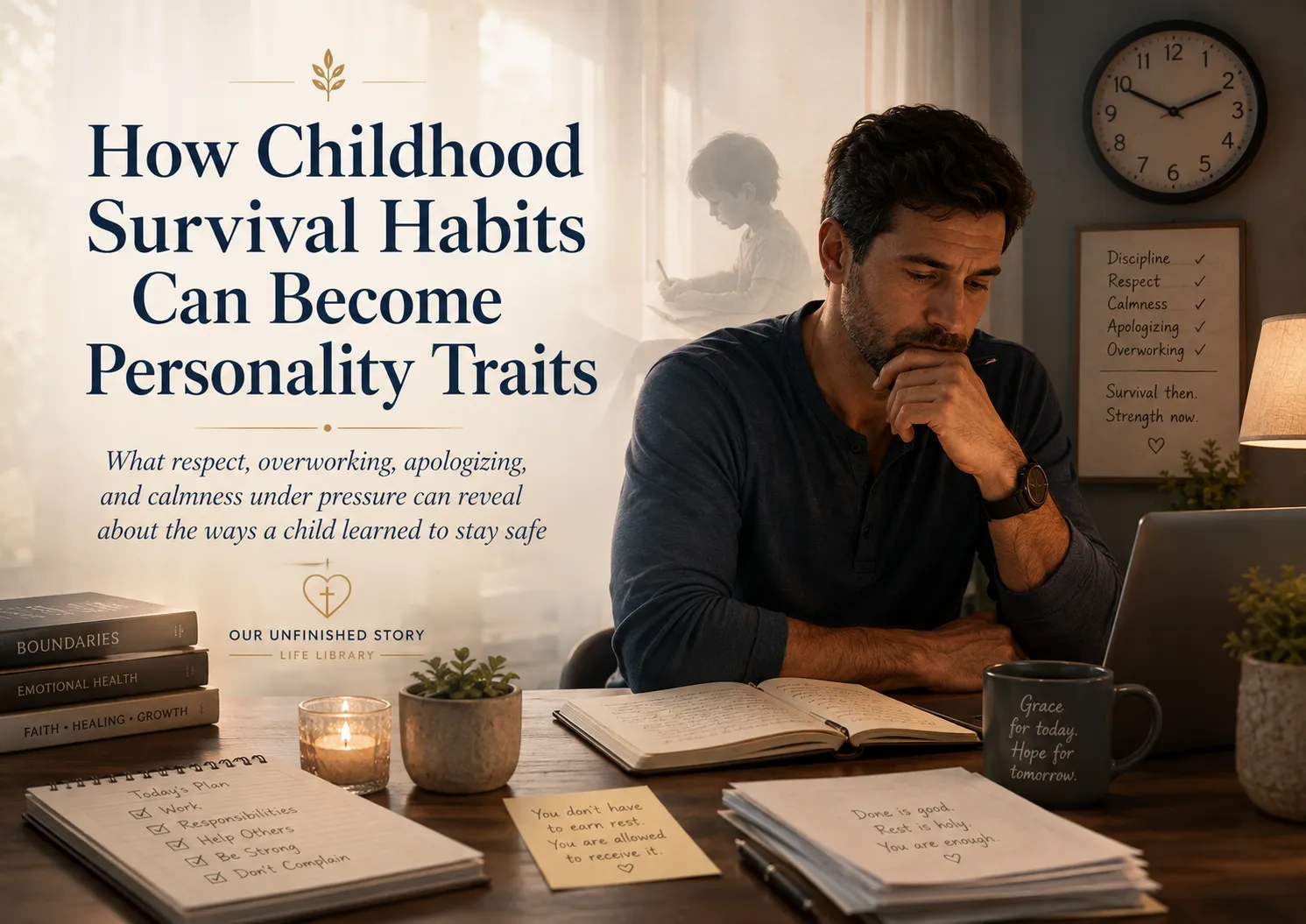
Childhood survival habits can follow you into adulthood so quietly that they begin to feel like personality traits.
You may call yourself independent, respectful, hardworking, calm, patient, apologetic, or unusually responsible. Other people may praise those qualities without realizing that some of them began as ways to avoid punishment, disappointment, conflict, or the danger of needing someone unreliable.
That does not make those qualities false.
It means their origin may be more complicated than it appears.
For much of my life, I believed certain traits simply described who I was.
I was respectful.
I stayed busy.
I apologized quickly.
I remained calm under pressure.
I tried to be kind, patient, useful, and easy to forgive.
Only later did I begin asking a harder question:
How much of that was my personality—and how much of it was a child learning what might keep him safer?
Why Childhood Survival Habits Can Feel Like Personality
Children do not usually think about survival in deliberate terms.
They do not sit down and decide to develop a personality that will help them navigate an unsafe or unpredictable home.
They adapt.
A child notices what leads to punishment and what seems to reduce it. He learns which emotions are welcomed, which needs create problems, and whether asking for help brings comfort or disappointment.
Then he repeats whatever appears to work.
Over time, those repeated behaviors become automatic.
They stop feeling like strategies.
They begin feeling like identity.
That is part of what How Childhood Emotional Neglect Teaches You to Survive explores. Survival does not always look dramatic from the outside. Sometimes it looks like becoming unusually mature, quiet, respectful, productive, or independent before you should have needed to be.
People may praise the result without seeing what created it.
They see the personality.
They do not always see the protection underneath it.
How Respect Can Become a Way to Avoid Punishment
Respect has always mattered deeply to me.
I believed that if I treated people respectfully, I would give them fewer reasons to be mean to me.
Respect was not only a value.
It was protection.
If I spoke carefully, stayed polite, followed instructions, and avoided challenging anyone, perhaps I could prevent the situation from becoming worse.
That belief followed me into adulthood.
I still place enormous value on treating people well. I do not want to embarrass, disrespect, or intentionally hurt someone. I try to understand where people are coming from before I react.
Those are qualities I want to keep.
But respect shaped by fear can become something different from healthy respect.
It can make disagreement feel dangerous.
It can make another person’s anger feel like proof that you did something wrong.
It can teach you to tolerate behavior you should challenge because speaking up feels more threatening than remaining quiet.
A respectful person should still be allowed to have boundaries.
You can speak calmly without surrendering your position.
You can disagree without becoming cruel.
You can protect someone’s dignity without giving them permission to disregard yours.
Healing does not require me to become disrespectful.
It requires me to learn that respect no longer has to mean making myself harmless enough that no one has a reason to hurt me.
Why Staying Busy Can Feel Safer Than Resting
I also learned to stay busy.
As a child, I felt that if I was working, studying, cleaning, practicing, or doing something productive, I was less likely to get in trouble.
Busyness gave me a role.
It made me useful.
It gave me fewer opportunities to attract the wrong kind of attention.
When the environment around you feels unpredictable, work can become more than work. It can become proof that you are behaving correctly.
That pattern stayed with me.
I became disciplined.
I learned constantly.
I worked for long hours.
I taught myself new skills.
I stayed productive even when no one was watching or celebrating the result.
Some people see me sitting at a computer and assume I am playing.
They do not see the work being completed, the programs being built, the writing being developed, or the education happening quietly on the screen.
They see stillness from the outside.
They do not see the labor inside it.
That misunderstanding can be frustrating, especially when productivity became one of the ways I learned to prove my value.
It connects naturally to When Love Feels Earned Through Work. When work first helps you avoid punishment or gain approval, it can become difficult to separate what you accomplish from what you believe you deserve.
Hard work is one of my strengths.
But a strength can still have an unhealthy demand attached to it.
The demand beneath mine often sounds like this:
Keep moving.
Stay useful.
Do not waste time.
Do not stop long enough for something to go wrong.
How Over-Apologizing Begins as Protection
Apologizing became another survival habit.
I believed that if I apologized enough, someone might forgive me more quickly.
Maybe the punishment would become less severe.
Maybe the anger would pass.
Maybe the person would see that I understood what I had done and decide I had suffered enough.
Apologizing became a way of trying to control the emotional temperature around me.
That does not mean the apologies were always insincere.
I genuinely care when I hurt someone.
I believe accountability matters. I do not want pride to stop me from admitting when I was wrong.
But there is a difference between taking responsibility and automatically accepting blame.
Over-apologizing can make you responsible for every uncomfortable moment.
You may apologize when someone misunderstands you.
You may apologize for having needs.
You may apologize for disagreeing.
You may even apologize when someone else hurts you because ending the tension feels safer than waiting for them to recognize their part.
For readers who apologize constantly, the useful question may not be only, “Did I do something wrong?”
It may also be:
“Am I apologizing because I caused harm, or because another person’s disappointment still feels dangerous?”
A healthy apology can repair connection.
A survival apology may erase you to preserve it.
Why Calmness Under Pressure Can Hide Constant Readiness
People sometimes praise how calm I remain under pressure.
I can handle emergencies.
I can think while other people panic.
I can stay patient when something becomes stressful.
From the outside, that looks like natural composure.
Some of it is.
But calmness under pressure can also develop when pressure is familiar.
If you grow up having to manage unpredictable situations, panic is not always useful. You learn to observe, calculate, and respond.
You become good at functioning while something is wrong.
That ability helped me through periods of confinement, abuse, instability, and times when I had very little support.
Resilience kept me moving.
It helped me survive experiences that could have overwhelmed me.
But being calm during danger does not always mean you feel safe when danger is absent.
Sometimes the person who performs best during a crisis struggles most when nothing needs to be handled.
Crisis provides direction.
Peace creates space.
And space can feel unfamiliar when readiness has become your normal posture.
That is part of the connection to Why My Body Reacted Before I Understood the Danger. A person can appear composed while still carrying an internal expectation that something may change without warning.
The calmness is real.
So is the readiness underneath it.
When Resilience Is Praised but the Work Behind It Is Invisible
Resilience is probably the survival trait that has helped me most.
I endured.
I adapted.
I kept learning.
I built structure where structure was missing.
I learned to rely on myself when relying on other people often ended in disappointment.
Resilience helped me continue through circumstances where giving up would have been understandable.
But resilience can create a misleading picture.
People see that you survived and assume the experience no longer affects you.
They see competence and assume you never need support.
They see productivity and assume the effort comes easily.
They see patience and assume nothing is happening underneath it.
Sometimes the people closest to me have seen me as lazy because they could not see the work I was doing. Others have praised my productivity without recognizing how difficult it is for me to stop.
Both views miss part of the truth.
I am hardworking.
I am also tired.
I am resilient.
I also learned resilience because I had to endure more than a child should have carried.
Strength can be genuine without making its origin good.
I can appreciate what resilience gave me without pretending I should have needed it so early.
Why Being “Too Nice” Can Make Other People Suspicious
I sometimes describe myself as too nice.
I try to be respectful.
I apologize.
I remain available.
I avoid unnecessary confrontation.
I try to understand rather than attack.
But excessive niceness can confuse people.
Some may wonder whether there is an ulterior motive. Others may assume kindness must be hiding an expectation because they are not accustomed to receiving it without a visible transaction.
Sometimes the confusion also comes from the way survival-shaped kindness presents itself.
If I am always agreeable, constantly apologizing, and hesitant to state what I want, another person may struggle to know where I truly stand.
They see kindness.
But they may not see a clear boundary, preference, or need behind it.
Healthy kindness does not require becoming smaller.
It can include honesty.
It can include saying no.
It can include admitting frustration before resentment grows.
It can include allowing someone to be temporarily disappointed without treating their disappointment as danger.
I do not want healing to make me less kind.
I want it to make my kindness freer.
Kind because I choose it.
Not kind because I am afraid of what might happen if I am anything else.
How to Keep the Strength Without Staying in Survival Mode
Recognizing a survival habit does not mean every part of it must be removed.
I do not want to lose discipline.
I do not want to stop being respectful.
I do not want to become careless about how my behavior affects people.
I do not want resilience replaced with helplessness.
The goal is not to become the opposite of the person survival helped me become.
The goal is to separate the strength from the fear that still controls it.
I can keep respect without becoming unable to disagree.
I can keep discipline without believing every quiet moment is wasted.
I can apologize without automatically accepting all the blame.
I can remain calm under pressure without living as though pressure is always coming.
I can stay resilient while admitting that I sometimes need help.
This is part of what How Discipline Became My Survival continues to teach me. Discipline gave me structure, direction, and control when those things were missing.
But discipline was supposed to become a tool.
It was never supposed to become a guard standing between me and rest.
Why Rest Can Feel Dangerous After Childhood Trauma
Rest is probably where this pattern remains most visible.
I rarely rest.
When I do, part of me feels unproductive.
Another part feels exposed.
Work has direction. Rest does not always tell me what I am accomplishing.
Productivity proves that I am using my time well. Rest asks me to believe that my value continues even when I am not producing anything.
That is difficult when staying busy once felt safer.
For someone whose childhood survival habits included constant work, rest may feel irresponsible even when the body needs it.
You may sit down and immediately think about what should be completed.
You may feel guilty while watching something, taking a nap, or doing nothing measurable.
You may call exhaustion discipline because admitting you need recovery feels too close to admitting weakness.
But rest is not the absence of discipline.
Sometimes rest is what allows discipline to remain healthy.
I am still learning that distinction.
I know how to keep going.
I am less experienced at stopping without feeling that I am risking something.
A Scripture I’m Carrying
“When thou liest down, thou shalt not be afraid: yea, thou shalt lie down, and thy sleep shall be sweet.”
— Proverbs 3:24
What stands out to me is not only the promise of sleep.
It is the absence of fear.
For someone who learned that rest meant losing awareness, becoming unproductive, or leaving room for trouble, lying down without fear is not a small image.
It represents safety.
The kind of safety where nothing has to be proven.
Where vigilance can loosen.
Where discipline can step away without everything collapsing.
I am not fully there yet.
But I am beginning to understand that rest does not have to mean danger.
What This Chapter Taught Me
Some qualities that look like personality may have begun as protection.
Respect may have begun as a way to prevent cruelty.
Hard work may have begun as a way to stay out of trouble.
Apologizing may have begun as an attempt to reduce punishment.
Calmness may have grown from learning how to function while something was wrong.
Resilience may have developed because stopping was never presented as an option.
Those origins do not make the qualities fake.
They explain why the qualities can be so difficult to loosen, even when they begin costing more than they protect.
Healing does not require me to reject the person I became.
It asks me to understand him.
To recognize what kept him alive.
To thank those habits for what they did.
And then to decide which ones still belong in the life I am living now.
I can remain disciplined without treating rest as danger.
I can remain kind without being afraid to become clear.
I can remain respectful without disappearing inside someone else’s expectations.
I can remain resilient without pretending I never need support.
Survival helped form my personality.
But survival does not have to control every part of the person I am still becoming.
Continue the Story
- Why Being Seen Can Feel Unsafe After Childhood Trauma
How attention can begin feeling dangerous when being noticed once led to scrutiny, punishment, or pain. - Why Old Patterns Still Show Up After Growth Begins
Why understanding a survival habit does not make it disappear immediately—and how growth continues when old reactions return. - How to Break the Workaholic Pattern as a Father
How survival-driven productivity can affect family presence, rest, and the example passed to the next generation.
Move Through This Book