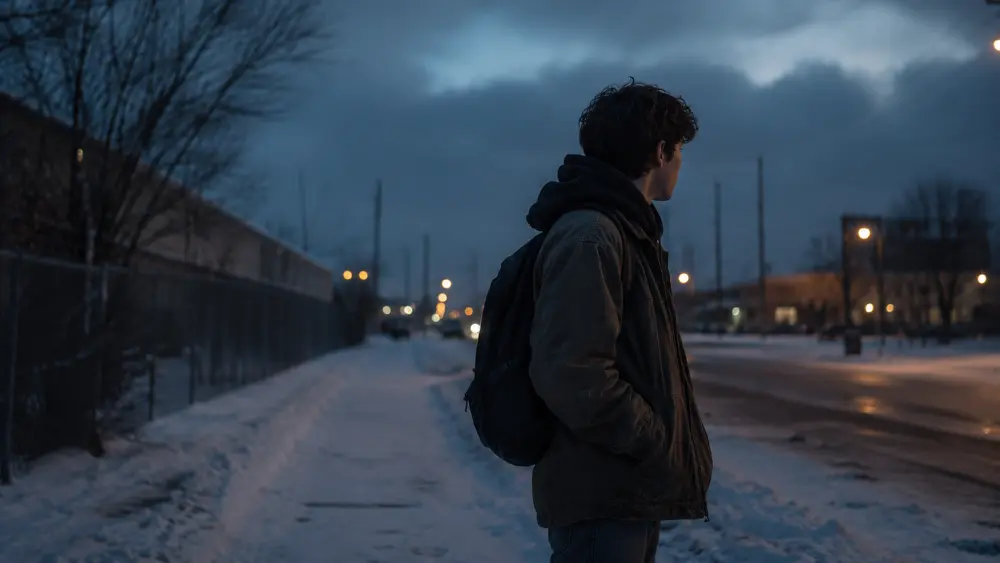
Being homeless at 17 changes how you understand safety, trust, independence, and survival. When there is no support system, no guidance, and no place to land, survival becomes something you learn quickly because life does not slow down long enough to teach it gently.
This is what that experience looked like for me.
There is a difference between growing up and being cut loose.
I did not step into adulthood.
I was pushed into it.
By seventeen, I no longer belonged anywhere.
No room that was mine.
No place that felt safe.
No adult stepping in to soften the landing.
Just winter.
When There Is No One Left to Call
People often imagine homelessness as loud.
Sirens.
Chaos.
Desperation.
What I remember most is how quiet it was.
Quiet decisions.
Quiet fear.
Quiet nights wondering how cold a body can get before it stops waking up.
I learned quickly that survival requires awareness.
Where to sleep.
How to stay unseen.
How to conserve energy.
How to endure discomfort without panic.
No one teaches you those things in a classroom.
You learn them because the alternative is not making it.
Four Months That Changed How Safety Felt
A Michigan winter does not negotiate.
It does not care how old you are.
It does not care how much you have already endured.
It does not care whether someone should have protected you.
There were nights when the cold felt alive, creeping into my bones, my breath, and my thoughts. Nights where I wondered if this was how it would end: quietly, unnoticed, frozen into stillness.
I did not nearly freeze to death because I was reckless.
I nearly froze to death because I was alone.
Those months taught my body lessons it never forgot. I learned how to stay alert, how to sleep lightly, how to keep moving when hope felt thin, and how to endure discomfort without complaint.
Even now, warmth can feel unfamiliar.
Rest can feel unsafe.
The body remembers what the mind wishes it could forget.
Independence Born From Absence
There was no heroic moment where everything clicked into place.
No sudden strength.
No dramatic turning point.
No speech that made me feel brave.
Just a slow realization:
If I wanted to live, I had to rely on myself.
That kind of independence does not feel empowering at first. It feels heavy. Lonely. Relentless.
But it changes you.
I stopped expecting rescue.
I stopped waiting for fairness.
I stopped believing someone would automatically step in.
Instead, I learned how to carry myself through impossible situations one quiet decision at a time.
Why Asking for Help Still Feels Hard
Even now, years later, asking for help can feel unnatural.
Dangerous.
Exposing.
Like I am admitting something I should have already learned how to carry alone.
That instinct was built here, in the months where needing help and receiving none became normal.
It did not stay in those months either. It followed me into the way I approached discipline, control, and self-reliance long after life became more stable. I explore that more in How Discipline Became My Survival.
Self-reliance kept me alive.
But it also taught me to hide my needs, downplay my pain, and believe I had to earn every ounce of support.
Healing, I am learning, is slowly unlearning that lesson.
What Homelessness Took and What It Gave
I do not romanticize that season.
I survived it.
Those months took things from me: any illusion of security, trust in systems that were supposed to protect, and the belief that hard work is always met with help.
But they also gave me something I still carry.
Grit.
Perspective.
Compassion for the unseen.
Gratitude for small mercies.
A refusal to look away from suffering.
Survival, when it comes too early, becomes part of who you are.
Not the whole story.
But part of it.
Standing on the Edge of What Came Next
By the time winter loosened its grip, I was no longer a child in any real sense of the word.
I had learned how to endure.
I had learned how to move forward without assurance.
I had learned how to stand on my own feet, even when they were numb.
This was not the end of my story.
But it was the end of my childhood.
What came next would be about building something out of nothing: a life, a future, and eventually a man who would one day try to give his children what he never had.
But that belongs to the chapters ahead.
What This Chapter Taught Me
This chapter taught me that survival can become strength, but it can also become a pattern that has to be healed later.
It taught me that independence is not always born from confidence. Sometimes it is born from absence.
It taught me that needing help is not weakness, even when life once made help feel unavailable.
And it taught me that surviving something does not mean it stopped affecting you.
Sometimes healing begins when you finally stop calling every survival instinct a personality trait.
A Scripture I’m Carrying
Psalm 27:10 meets this chapter quietly because it does not pretend abandonment is small. It names the wound while still pointing toward being received.
“Though my father and mother forsake me, the Lord will receive me.”
Continue the Story
These chapters continue the journey from survival into discipline, identity, and the life that followed:
- How Discipline Became My Survival
How discipline became a way to survive when no one else stepped in. - How Childhood Trauma Affects You as an Adult
The parts of survival that didn't stay in the past. - How to Break the Workaholic Pattern as a Father
Choosing not to let survival define the man I would become.
Move Through This Book