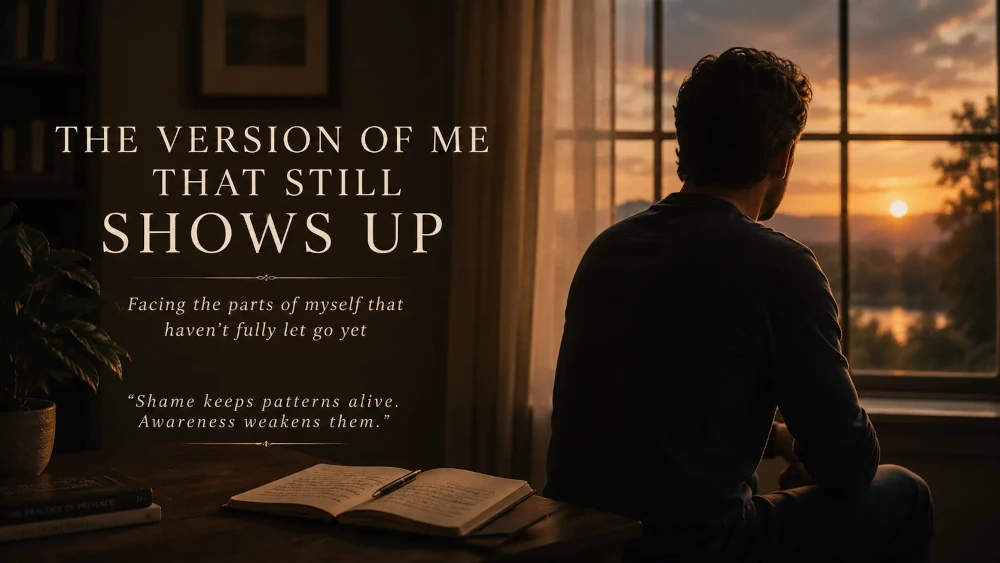
Old patterns can still show up even after personal growth begins. If you have ever recognized an old reaction, an old fear, or an old survival habit inside yourself and wondered why it was still there, this chapter is about learning to face those moments without shame.
Growth does not erase the past all at once.
Sometimes it reveals what still needs gentleness.
When Old Patterns Knock
Growth does not erase the past.
It reveals it.
Even after awareness sets in, there are moments when an older version of me still shows up. Not because I want him to. Not because I have not changed at all. But because habits formed in survival do not disappear just because I finally understand them.
They surface when I am tired.
When I feel misunderstood.
When something matters more than I am ready to admit.
When silence feels too familiar.
When fear speaks faster than wisdom.
That version of me is not evil. He is not hopeless. He is not proof that I have failed.
He is familiar.
And familiarity has a way of slipping back in when I am not paying attention.
That is one of the harder parts of becoming. Growth does not always mean the old version of me disappears. Sometimes it means I recognize him sooner when he arrives.
That recognition matters.
Because what I can recognize, I can begin to interrupt.
Recognition Without Shame
There was a time when noticing these moments would have sent me spiraling into self-judgment.
I would have asked myself, “Why am I still like this?”
Why am I still reactive?
Why am I still afraid?
Why does this still bother me?
Why did I respond that way again?
But shame rarely helps me grow. Most of the time, shame keeps me stuck in the very patterns I am trying to outgrow. It makes me hide. It makes me defend. It makes me pretend I did not see what I saw.
Awareness does something different.
Awareness lets me tell the truth without turning that truth into a sentence against myself.
Shame keeps patterns alive. Awareness weakens them.
Instead of asking, “Why am I still like this?” I am learning to ask, “What is this part of me trying to protect?”
That question changes the conversation.
Often, the answer is not anger.
It is fear.
Fear of loss.
Fear of being overlooked.
Fear of being misunderstood.
Fear of repeating pain I swore I would never relive.
Fear that if I do not react quickly enough, something important will slip away.
That does not excuse every reaction. It does not remove responsibility. But it helps me understand what is actually happening beneath the surface.
And understanding gives me a better place to begin.
That is why How to Pause Before Reacting matters in this journey. Sometimes growth begins in the moment I notice an old instinct and choose not to let it speak first.
Growth Is Not a Clean Break
Becoming is not a clean exit from who I was.
It is a gradual handoff.
Some days, the wiser version of me leads.
Other days, the older instincts reach for the wheel.
The difference now is that I notice sooner.
I interrupt faster.
I apologize with more clarity.
I do not pretend I did not see it happen.
That awareness does not make me perfect, but it does make me honest.
For a long time, I thought growth meant I would reach a point where the old version of me never appeared again. I thought healing would eventually remove every reaction, every insecurity, every fear, every reflex that came from survival.
But I am learning that growth is not always the absence of the old pattern.
Sometimes growth is what happens after the old pattern appears.
Do I deny it?
Do I defend it?
Do I excuse it?
Or do I notice it, own it, and choose differently next time?
That is the uncomfortable middle of becoming.
Not fully free from every old instinct.
But no longer blind to them either.
That connects naturally to Why Personal Growth Feels Slow, because some of the deepest growth happens quietly, in the hidden space between awareness and change.
The Older Version Was Trying to Survive
One thing I am learning is that the older version of me did not appear out of nowhere.
He was shaped.
He was formed by moments where safety did not feel certain, where love felt unstable, where silence carried threat, where being misunderstood felt dangerous.
He learned to react because reacting felt safer than waiting.
He learned to defend because being defenseless once hurt.
He learned to brace because peace was unfamiliar.
He learned to expect loss because loss had already taught him too much.
I can look at that version of myself with frustration.
Or I can look at him with compassion.
Not permission.
Compassion.
There is a difference.
Permission says, “This is just who I am, so I do not need to change.”
Compassion says, “This is where it came from, and now I can learn a different way.”
That difference matters.
Because I do not want to shame the version of me that helped me survive. But I also do not want him leading every conversation, every relationship, every conflict, every decision, or every moment where fear tries to speak louder than love.
He had a role.
He helped me get here.
But he does not get the final word anymore.
Grace for the In-Between
Faith has taught me that grace is not reserved for the finished product.
Grace meets me in the middle.
While I am still learning.
Still adjusting.
Still undoing years of conditioning.
Still noticing things I wish were already healed.
That is hard for me to accept sometimes because I want growth to feel cleaner than it does. I want to be able to point to a lesson and say, “I learned that. I am done with it now.”
But becoming does not usually work that way.
Sometimes God lets me revisit the same lesson from a deeper place.
Not because I failed the first time.
But because another layer is ready to be healed.
That is where grace becomes more than a word to me. It becomes the room God gives me to keep becoming without pretending I have arrived.
“My grace is sufficient for you, for my power is made perfect in weakness.”
— 2 Corinthians 12:9
Weakness does not disqualify growth.
It reveals where growth is still happening.
That verse does not make me feel ashamed for still having unfinished places. It reminds me that God is not waiting for me to become flawless before He meets me there.
He meets me while I am still becoming.
Choosing Who Speaks Next
The version of me that still shows up does not get the final word anymore.
He may knock.
But I decide who answers.
Sometimes that decision comes quickly.
Sometimes it comes late.
Sometimes I only recognize the old pattern after I have already reacted from it.
But even then, awareness still matters.
Because the goal is not to pretend I never struggle.
The goal is to become honest enough to see the struggle clearly, humble enough to take responsibility, and hopeful enough to keep growing.
I cannot control every old instinct that rises in me.
But I can learn not to obey every one of them.
I can pause.
I can ask what is really happening inside me.
I can tell the truth without letting shame take over.
I can apologize when the older version of me speaks louder than the man I am becoming.
I can return to grace without using grace as an excuse.
That is the work.
Slow.
Quiet.
Uncomfortable.
But real.
And maybe that is what becoming looks like more often than I expected.
Not a perfect new self replacing the old one overnight.
But a more honest self learning how to respond when the old one still knocks.
What This Chapter Taught Me
Old patterns can still show up after growth begins.
Recognizing an old reaction does not mean I have failed; it may mean I am finally aware enough to see it.
Shame keeps patterns hidden, but awareness brings them into the light where growth can begin.
The older version of me may explain some of my reactions, but he does not have to control what I choose next.
Grace meets me in the unfinished middle, not only after I have arrived.
And becoming means learning who gets to speak next.
Continue the Story
These chapters continue the journey through old patterns, restraint, slow growth, and the grace needed to keep becoming honestly:
-
How to Pause Before Reacting
A reflection on urgency, restraint, and learning to choose silence before old instincts take over. -
Why Personal Growth Feels Slow
A reflection on honoring slow growth, trusting God’s process, and recognizing that becoming often happens before progress is visible. -
Why Personal Growth Can Feel Like Loss
Understanding the quiet cost of becoming and trusting God when letting go hurts.
Move Through This Book