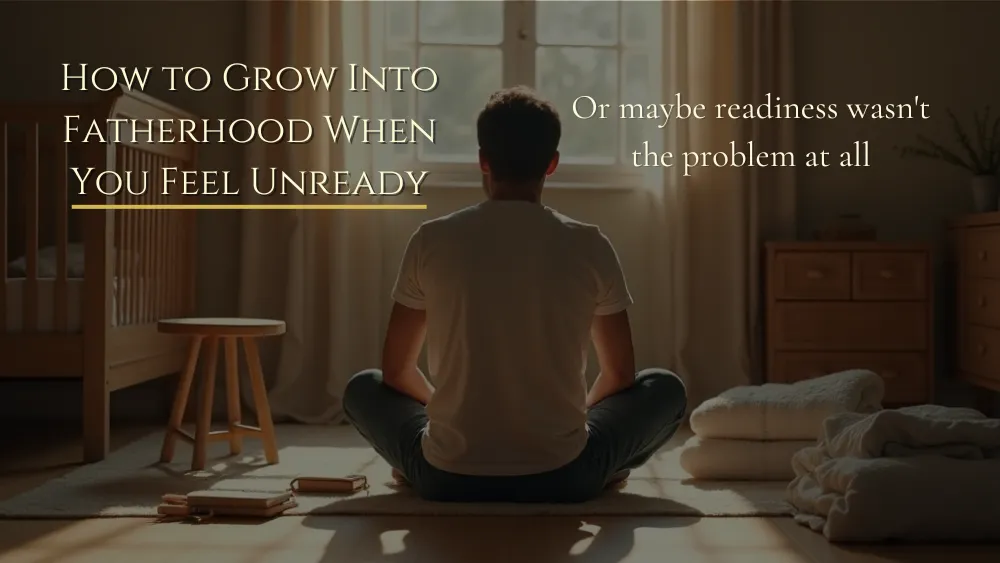
Feeling unready for fatherhood does not always mean you lack love, responsibility, or desire. Sometimes it means you were trying to grow into one of life’s biggest roles while carrying fear, criticism, and old wounds that made every mistake feel like proof you were failing. This chapter is about wanting to be a father, questioning whether I was ready, and learning that becoming requires room to grow.
The Moment I Thought I Was Ready
The first time I realized wanting something does not always mean I am ready to receive it was when I became a father.
I wanted to be a father.
Genuinely.
I wanted a family.
I wanted purpose.
I wanted to do better than what I came from.
And when my first child arrived, I stepped up the only way I knew how.
By working harder.
Sacrificing more.
Taking responsibility seriously.
Trying to provide.
Trying to be present.
Trying to prove that I was not careless, absent, or indifferent.
I was not perfect.
No parent is.
But I was not someone who did not care.
That distinction matters to me because fatherhood was never something I treated lightly. I may not have understood everything it would require of me emotionally, but I wanted to love my children well.
Still, wanting something and being equipped for it are not always the same thing.
At least, that is what I have wrestled with.
Doing My Best Under Constant Criticism
For a long time, it felt like my parenting was being evaluated before it was being understood.
Not through close observation of my heart.
Not through curiosity about what I was trying to learn.
Not through honest conversation about what support might help me grow.
But through criticism.
Correction.
Commentary.
The kind of judgment that made every decision feel temporary, like it could be overturned by someone else’s opinion at any moment.
That kind of pressure changes how you parent.
It makes you second-guess ordinary choices.
It makes growth feel unsafe.
It makes you wonder whether you are actually learning or simply trying to avoid being criticized again.
I was not parenting in a vacuum.
I was parenting while carrying the weight of other people’s expectations.
And no matter what I did, it often felt like it was never right.
That connects closely to How Fatherhood Changes You, because fatherhood does not only reveal your love. It reveals your fears, your wounds, your need for support, and the places where you are still learning how to stand.
When Encouragement Was Missing
One of the parts that still hurts more than I like to admit is how little encouragement I remember receiving.
Becoming a parent is a life-changing moment.
It is heavy.
It is sacred.
It is terrifying.
It is beautiful.
It deserves, at the very least, a pause.
A word of encouragement.
A moment of recognition.
A reminder that you are stepping into something meaningful, even if you still have a lot to learn.
But often, what I remember most is not celebration.
I remember being warned.
Questioned.
Corrected.
Told in different ways that I was making a mistake.
That kind of response gets inside you.
Especially when you already come from places where love felt conditional and approval felt difficult to earn.
It can make you feel like fatherhood began with a verdict instead of a blessing.
And maybe that is why this chapter still feels tender.
Because I was not asking anyone to pretend I had everything figured out.
I just wanted space to become.
When Improvement Became Evidence Against Me
There were moments when I tried to grow, and even the attempt felt used against me.
I remember trying to teach one of my children responsibility through a small household task.
Not because I did not want to help.
Not because I was trying to avoid being a parent.
But because I wanted my child to learn independence, pride, and the quiet confidence that comes from doing something on their own.
Instead of being seen as teaching, it was interpreted as laziness.
Another time, I received criticism about something practical in my parenting. I took it seriously. I adjusted. I tried to respond in a way that showed I was listening.
Then the adjustment became wrong too.
That is when something started to sink in.
This was not always about improvement.
Sometimes it felt like control.
Because if I did not change, I was irresponsible.
If I did change, I was doing it wrong.
If I listened, I was weak.
If I did not listen, I was selfish.
There was no version of doing better that did not somehow become evidence that I was failing.
And over time, that wears something down inside you.
Especially when you are already questioning yourself.
The Impossible Standard
Parenting already comes with enough uncertainty.
You wonder if you are doing enough.
If you are too strict.
Too soft.
Too tired.
Too busy.
Too distracted.
Too shaped by the things you survived.
You wonder if your children will remember your effort or only your mistakes.
You wonder if love is enough when wisdom is still forming.
So when criticism becomes constant, it does not create better parenting.
It creates hesitation.
You stop trusting your instincts.
You start parenting defensively.
You begin measuring decisions by how they will be judged instead of whether they are truly helpful.
That is exhausting.
And it is not the same as support.
Support helps a parent become more grounded.
Control makes a parent feel smaller.
Support gives room for growth.
Control punishes the process of becoming.
I needed guidance.
I needed wisdom.
I needed accountability in healthy ways.
But I also needed the space to grow into fatherhood without feeling dismantled every time I tried.
That is why How to Be a More Present Father belongs close to this chapter. Presence is not built through shame. It is built through responsibility, humility, learning, and the courage to keep showing up even when you know you are still becoming.
The Question I Could Not Avoid
So I have had to sit with an uncomfortable question.
Was I truly unready to be a parent?
Or was I ready in the only way I knew how to be ready, but never given the space to become one?
Because readiness is not only about knowledge.
It is also about autonomy.
It is about learning through experience.
It is about making mistakes without being reduced to those mistakes.
It is about receiving correction without feeling condemned.
It is about being allowed to grow without every imperfect step being treated like proof that you should not have tried.
I do not want to pretend readiness does not matter.
It does.
Children deserve parents who take growth seriously.
They deserve safety, consistency, patience, humility, and care.
But no parent becomes fully formed before the child arrives.
Fatherhood teaches you while you are living it.
And that means becoming a father requires more than desire.
It also requires room.
Room to learn.
Room to adjust.
Room to fail without being destroyed.
Room to become wiser than you were at the beginning.
What I Know Now
I know I loved my children.
I know I tried.
I know I adjusted when I was told I was wrong, even when the feedback felt confusing or contradictory.
I know I wanted to be better than what I came from.
And I know this now:
Constant interference does not produce confident parenting.
It produces doubt.
Hesitation.
Emotional exhaustion.
A fear of making decisions.
A sense that no matter what you do, someone else will always define your effort for you.
Maybe I was not fully ready when I became a father.
But maybe readiness was not the only missing piece.
Maybe what I needed was not less love for my children.
Maybe what I needed was distance from the voices that made growth feel impossible.
Not distance from responsibility.
Not distance from fatherhood.
Not distance from the children I loved.
Distance from the pressure that made becoming feel like failure before I had a chance to learn.
That connects naturally to How Childhood Punishment Shapes the Way You Discipline as a Father, because the way we were judged, corrected, or controlled can follow us into the way we experience parenting later.
Sometimes fatherhood is not only learning how to raise children.
It is learning how to stop raising yourself under old verdicts.
Still Becoming
I do not have a clean answer yet.
Maybe I was unready in some ways.
Maybe every parent is.
Maybe part of me wanted fatherhood before I understood the emotional cost.
Maybe part of me needed support I did not know how to ask for.
Maybe part of me was trying to become a good father while still healing from being a wounded son.
All of that can be true.
But this is also true:
Being told I was unready does not mean I was incapable.
Being criticized does not mean I did not care.
Being imperfect does not mean I was absent.
Being unfinished does not mean I was unworthy of the role.
Some lessons only become clear years later.
And some growth only happens once you step out from under the shadow of someone else’s expectations.
I am still becoming.
As a man.
As a father.
As someone who loves his children and still grieves the ways he wishes he had been stronger, calmer, wiser, and more whole.
That grief does not cancel the love.
It just reminds me how much the role mattered.
What This Chapter Taught Me
Wanting fatherhood and being fully equipped for fatherhood are not the same thing.
But feeling unready does not automatically mean someone lacks love, responsibility, or desire to grow.
Parents need accountability, but they also need room to learn without being dismantled by shame.
Constant criticism can make growth harder by turning every adjustment into evidence of failure.
I am learning that fatherhood is not only about whether I was ready at the beginning.
It is about whether I kept becoming.
Whether I kept loving.
Whether I kept learning.
Whether I kept choosing responsibility even when I carried doubt.
And I did.
Imperfectly.
But honestly.
Scripture Reflection
“For the LORD seeth not as man seeth; for man looketh on the outward appearance, but the LORD looketh on the heart.”
— 1 Samuel 16:7
This verse fits this chapter because so much of my struggle has been about being judged from the outside.
What people thought they saw.
What they assumed.
What they believed about my readiness, my choices, or my capacity to grow.
But God sees deeper than appearances.
He sees the heart.
He sees effort that others miss.
He sees love beneath imperfect expression.
He sees the father still becoming, even when the process looks unfinished from the outside.
That does not excuse every mistake.
But it does remind me that my story is not fully measured by someone else’s judgment.
God knows the heart I brought to fatherhood.
And He knows the man I am still becoming.
Continue the Story
These chapters continue the journey through fatherhood, growth, responsibility, and learning how to become beyond old expectations:
-
How Fatherhood Changes You
For understanding how fatherhood reshapes love, responsibility, sacrifice, and the way a man sees himself. -
How to Be a More Present Father
For reflecting on presence, attention, and the kind of fatherhood that is built through ordinary moments. -
How Childhood Punishment Shapes the Way You Discipline as a Father
For exploring how old patterns of correction can follow us into parenting unless we learn to recognize and interrupt them.
Move Through This Book