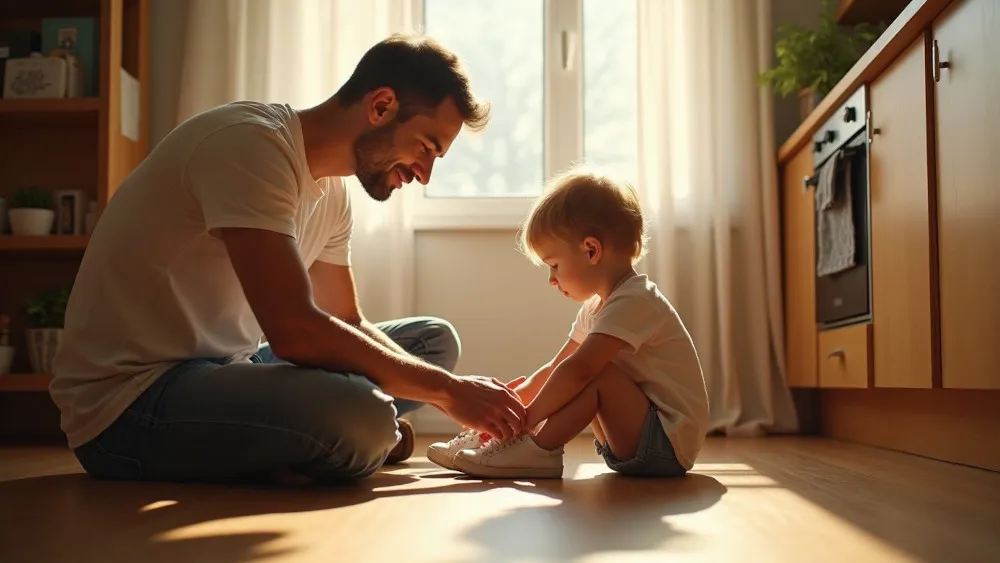
What Children Learn From Their Father Without Being Taught
Children learn more from a father’s life than his lectures. They notice tone, habits, reactions, consistency, apologies, work ethic, faith, patience, and the way ordinary moments are handled long before they can explain what those patterns are teaching them.
I have realized that most of what my children learn from me is not taught on purpose.
It is learned accidentally.
They are watching when I think they are not. Listening when I assume they are distracted. Absorbing tone, posture, and response more than instructions or explanations.
Legacy, it turns out, is not only something I leave behind.
It is something I live in front of them.
That truth changes the weight of ordinary days.
Because fatherhood is not only built in the big conversations. It is built in the repeated ones. The rushed mornings. The tired evenings. The way I speak when I am frustrated. The way I apologize when I am wrong. The way I carry responsibility when no one is clapping for it.
That connects closely to How Fatherhood Changes You, because fatherhood does not only rearrange priorities. It also reveals that someone is learning from the way I live those priorities out.
The Lessons I Never Planned to Teach
I teach values without always meaning to.
Through how I handle stress.
Through how I speak when I am frustrated.
Through how I respond when plans change.
Through how I recover when I am wrong.
They see how I solve problems.
They see how I react to setbacks.
They notice whether responsibility feels like resentment or love.
Even silence teaches something.
In family life, the smallest patterns carry the most weight. Routines. Reactions. What gets ignored. What gets addressed. What gets repeated.
Those moments do not feel like teaching.
But they are.
A child may forget a lecture. But they remember how the room felt. They remember whether love felt safe. They remember whether mistakes could be repaired. They remember whether honesty led to connection or distance.
That is the part that keeps me paying attention.
Not perfectly.
But more intentionally than before.
When My Habits Become Their Normal
Every home teaches a definition of normal.
Not always through rules.
Sometimes through atmosphere.
If conflict is always loud, loudness becomes normal. If apologies never happen, pride becomes normal. If exhaustion always turns into anger, anger starts feeling expected. If love is only shown through provision, children may grow up believing presence is optional.
That is a heavy thought.
Because I know I am not only raising children.
I am helping shape what they may one day expect from love, family, responsibility, and themselves.
That is why this chapter is different from How Fatherhood Teaches Patience Through Everyday Moments. Patience is one piece of the example. But this chapter is wider than patience. It is about the full pattern my children may carry forward.
The tone I repeat.
The repair I model.
The responsibility I normalize.
The faith I live quietly.
The way I treat people when I am tired.
The way I respond when life does not go my way.
Those things become part of the emotional language of the home.
And someday, they may become part of the emotional language my children carry into their own lives.
Self-Reliance, Rewritten
I have always believed in self-reliance.
It was necessary once.
Survival demanded it.
But fatherhood has forced me to redefine it.
I do not want my children to feel like they are on their own the way I once did. I do not want independence to feel like abandonment. I do not want strength to mean silence. I do not want capability to come at the cost of connection.
I want them to feel capable and supported.
Independent and connected.
Strong, but still able to ask for help.
That balance is delicate.
So I try to model self-reliance that does not reject help, strength that does not isolate, and confidence that still knows when to lean in.
They learn what independence looks like by watching how I carry it.
If I never ask for help, they may learn that needing people is weakness.
If I never rest, they may learn that worth is measured by exhaustion.
If I never admit fear, they may learn that strength means hiding.
And I do not want to pass that forward.
That is part of why How to Break Generational Patterns as a Father matters so much in the Fatherhood Book. Some lessons have to be interrupted before they become inheritance.
Family Dynamics Are Always Teaching
Every household has its own emotional language.
How conflict is handled.
How forgiveness shows up.
How space is respected.
How needs are spoken.
How frustration is carried.
How love returns after hard moments.
I have come to understand that family dynamics do not only shape childhood memories.
They shape expectations for adulthood.
What love feels like.
What safety sounds like.
What responsibility means.
What normal becomes.
That realization keeps me paying attention.
Because children do not only learn from what is explained to them. They learn from what surrounds them.
They learn whether home is a place where emotions can be named.
They learn whether mistakes can be repaired.
They learn whether love remains steady after correction.
They learn whether people can disagree and still belong.
Those are quiet lessons.
But quiet does not mean small.
What I Hope They Carry
I know I will not model everything perfectly.
There will be moments I wish I handled better. Words I wish I softened. Days when I am tired, distracted, or less present than I want to be.
But perfection is not the legacy I am trying to leave.
I hope they carry honesty.
I hope they carry resilience without feeling alone.
I hope they carry faith without feeling forced.
I hope they carry responsibility without resentment.
I hope they remember that love was not only something I said.
It was something I tried to practice.
In the way I showed up.
In the way I kept learning.
In the way I came back after falling short.
In the way I tried to become the kind of father whose ordinary life taught something worth keeping.
A Legacy Built in Motion
“Impress them on your children. Talk about them when you sit at home and when you walk along the road, when you lie down and when you get up.”
That verse reminds me that legacy is not reserved for special moments.
It is embedded in daily life.
In car rides.
In corrections.
In conversations that feel forgettable at the time.
In routines no one photographs.
In the quiet repetition of what matters.
I do not know exactly what my children will carry forward.
But I know this:
What I repeat will outlast what I explain.
So I keep trying.
Not because I have mastered fatherhood.
But because I understand now that my life is teaching even when my mouth is not.
What This Chapter Taught Me
Children learn from what they see repeated, not only from what they are told.
Legacy is formed in ordinary moments: tone, habits, reactions, apologies, routines, and the emotional atmosphere of the home.
Self-reliance can be modeled in a healthier way when strength stays connected to support, humility, and the willingness to ask for help.
Fatherhood is not only about teaching lessons.
It is about becoming someone whose life teaches something worth carrying.
Continue the Story
- How Fatherhood Changes You
How fatherhood reshapes responsibility, priorities, presence, and the quiet decision to keep showing up. - How Fatherhood Teaches Patience Through Everyday Moments
A reflection on restraint, calm, and the way children learn from how we respond under pressure. - How to Break Generational Patterns as a Father
How fatherhood invites me to interrupt the parts of my past that should not become my children’s inheritance.
Move Through This Book