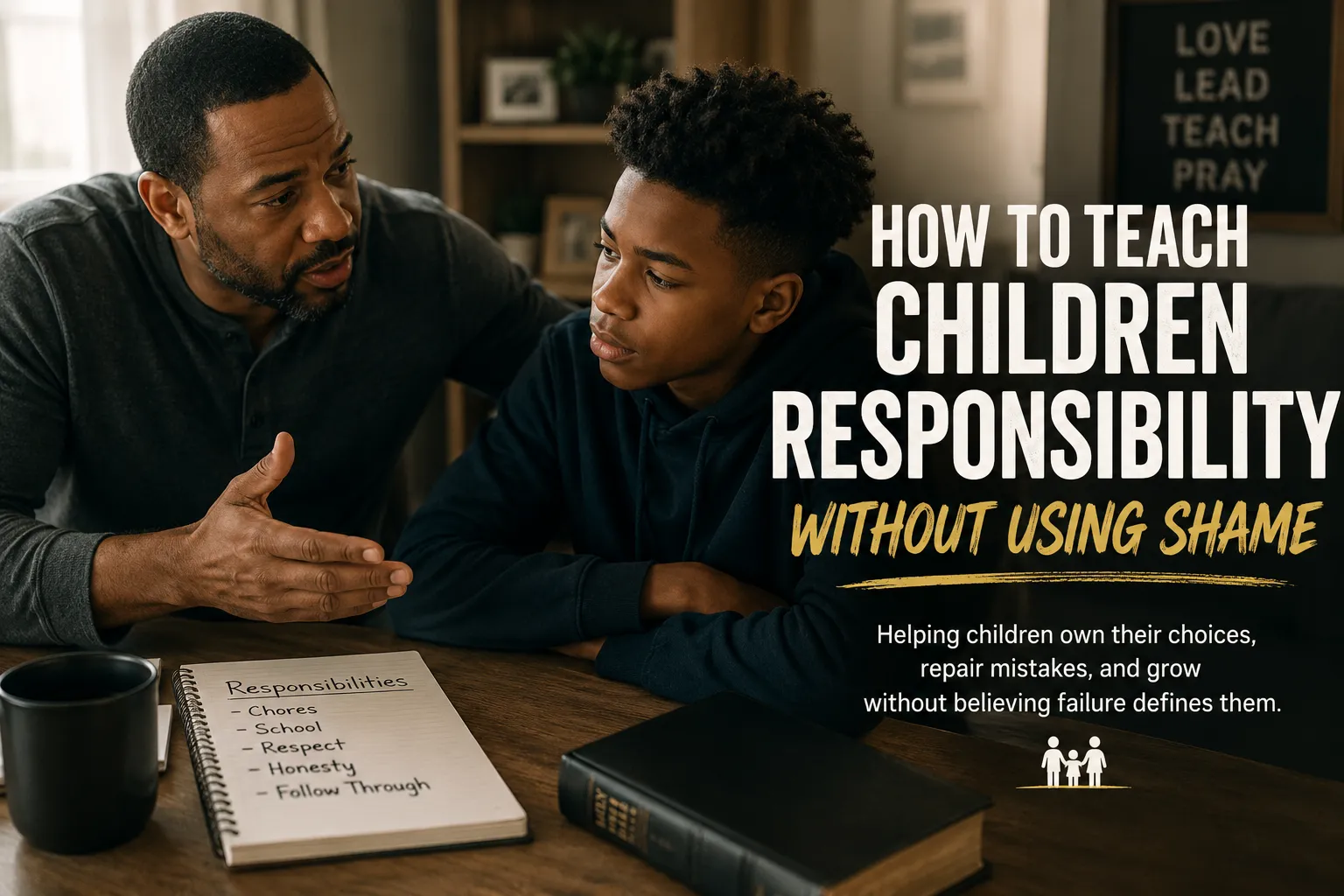
Teaching children responsibility without shame means holding them accountable while protecting their dignity. Children still need chores, consequences, honesty, follow-through, and respect for other people’s property. But if correction makes them believe they are lazy, hopeless, bad, or permanently disappointing, they may learn to hide mistakes instead of taking responsibility for them.
This chapter is about the line I am still learning to walk as a father: expecting more from my children without making their failures feel bigger than their worth.
The Child Who Gets Asked Because He Usually Does It
One of my children has always been one of the hardest workers in the house.
He has mowed the lawn.
He has watered the garden.
He has helped with physical work that the others usually avoid.
He has often been given more responsibilities than the other children—not necessarily because that is fair, but because asking him has traditionally created less of a fight.
That is something I have had to think about.
Sometimes the child who argues the least becomes the child who is asked to do the most.
The responsible child becomes the convenient child.
The cooperative child receives additional work because asking someone else would require more energy, more arguing, or more correction.
That can create an unhealthy lesson:
Being dependable only earns you more burdens.
The reward for cooperation should not be endless extra responsibility.
Lately, even this child has begun resisting in quieter ways.
He does not always argue.
He often says, “Okay.”
But then the task does not happen.
The lawn remains unfinished.
The item stays where it was.
The responsibility disappears from his attention until someone asks again.
And again.
That has forced me to ask whether I am only seeing defiance—or whether I am also seeing frustration, uneven expectations, distraction, exhaustion, or a child who has learned that saying “okay” ends the immediate conversation.
Saying “Okay” Is Not the Same as Following Through
Responsibility is not agreeing to do something.
It is completing it.
That is one of the lessons I want my children to understand.
Words matter.
Commitments matter.
When someone asks you to do something reasonable and you agree, your responsibility does not end when the conversation ends.
It ends when the work is completed.
That applies to chores.
Schoolwork.
Cleaning up after yourself.
Respecting property.
Keeping promises.
Treating siblings with care.
Telling the truth when admitting the truth may bring consequences.
These are recurring struggles in our home.
Tasks are avoided.
Schoolwork becomes a battle.
Messes are left for someone else.
Excuses replace ownership.
Property is not always treated respectfully.
Sibling relationships can become harsh instead of helpful.
Promises are made and then forgotten.
As a father, that disappoints me because I believe I have taught them better.
But disappointment can become dangerous when it changes from:
I know you are capable of better choices.
into:
You should already be better than this.
The first communicates belief.
The second can begin communicating rejection.
That distinction matters because How Fatherhood Turns Responsibility Into Love reminds me that responsibility is not simply pressure or obligation. It is care attached to the choices we make and the people those choices affect.
Consequences Should Connect to the Choice
When a task is repeatedly ignored, privileges may be paused.
Video games are one example.
If a child refuses responsibilities but expects immediate access to entertainment, losing that privilege can be a connected consequence. Responsibility comes before recreation.
The anger that follows does not automatically mean the consequence was wrong.
Children often dislike consequences.
Adults do too.
But I still have to ask what the consequence is meant to accomplish.
Is it meant to teach?
Is it meant to restore balance?
Is it connected to the behavior?
Or am I trying to make the child feel as frustrated as I feel?
Some consequences happen naturally.
A child refuses to bring a jacket and feels cold.
Someone mishandles an item and no longer has that item available.
A mess is created, so the person who created it has to clean it.
A commitment is ignored, so the privilege connected to that commitment is delayed.
Other consequences have to be chosen by the parent.
Those should still be proportionate, understandable, and connected enough that the child can see the lesson.
The goal is not simply discomfort.
The goal is ownership.
A consequence should help answer:
What did I choose?
Who did it affect?
What needs to be repaired?
What can I do differently next time?
Shame Attacks Identity Instead of Behavior
Responsibility says:
You did not complete what you agreed to do.
Shame says:
You are lazy.
Responsibility says:
You damaged something, and now you need to help repair or replace it.
Shame says:
You ruin everything.
Responsibility says:
You lied, and the dishonesty damaged trust.
Shame says:
You are nothing but a liar.
The difference may sound small when a parent is frustrated.
It is not small to a child.
Behavior can change.
Choices can be repaired.
Skills can be learned.
But when the child’s identity becomes the target, correction stops being about growth.
It becomes a verdict.
There are times when children in our home hear discouraging messages from adults.
You cannot do that.
You will never succeed at that.
Grow up.
Stop acting like that.
Some of those words may come from frustration.
Some may be intended as realism.
But children often do not hear them as temporary correction.
They hear them as a description of who they are and what their future will be.
One of my children has spent years returning to creative goals, even without much structure or guidance. He has tried teaching himself skills. He has continued creating online. The progress may not look impressive to everyone yet, but the persistence is real.
Responsibility includes helping him understand planning, patience, discipline, and learning the basics.
Shame would tell him the dream proves he is foolish.
Encouragement does not require pretending every idea will succeed.
It means helping a child become capable enough to find out what is possible.
Why Shame Can Create More Hiding
When children expect humiliation, honesty becomes dangerous.
A child who believes every mistake will become a character attack has more reason to hide the mistake.
More reason to lie.
More reason to blame a sibling.
More reason to deny what happened.
More reason to say the task is finished when it is not.
That does not excuse dishonesty.
Children still need to be corrected for lying.
But correction should make truth safer than deception—not because the truth carries no consequence, but because telling the truth does not threaten the child’s belonging.
I want my children to know:
You may face a consequence.
You may need to repair what happened.
I may be disappointed in the decision.
But you can still come to me.
You are still my child.
Your mistake has not removed my love.
That is where How to Discipline Your Children Without Breaking Trust becomes important. Discipline should make honesty, responsibility, and connection stronger. It should not teach children that hiding is the only way to remain emotionally safe.
Responsibility grows when children learn how to repair mistakes, not when mistakes become their identity.
Different Children Need Different Correction
One of the hardest lessons in parenting is that consistency does not always mean treating every child identically.
The values should remain consistent.
Honesty matters.
Responsibility matters.
Respect matters.
Following through matters.
But the delivery may need to change.
One child may respond to losing a privilege.
Another may need a firm instruction and a clear deadline.
Another may become more resistant when voices rise and respond much better when the correction is calm, quiet, and direct.
Another may need the task broken into smaller steps.
Another may need fewer words and more structure.
That does not mean standards disappear.
It means the purpose of correction is learning—not proving that one parenting method must work for every child.
I am still learning this.
Sometimes I want one rule, one consequence, and one response that works for everyone.
Parenting rarely gives me that simplicity.
The child who ignores a task is not always ignoring it for the same reason as another child.
One may be testing limits.
One may be distracted.
One may feel overwhelmed.
One may be avoiding work.
One may have heard the instruction but not fully processed it.
The behavior still needs to be addressed.
But understanding the child helps me choose a response that has a better chance of teaching something.
When My Frustration Becomes Part of the Problem
There have been moments when repeated behavior, school problems, phone calls, embarrassment, and the feeling that nothing else was working pushed me beyond calm correction.
I reacted more harshly than I should have.
Later, I apologized.
But I am learning that a complete apology cannot sound like:
I am sorry, but you made me do it.
My child is responsible for his choices.
I am responsible for mine.
That does not remove the seriousness of what happened.
It does not mean I surrender authority.
It means I cannot teach ownership while refusing to own my own response.
I grew up with punishment that often arrived before explanation.
Pain was expected to produce obedience.
Fear was treated as respect.
The adult’s frustration became part of the consequence.
Those patterns can return when I am embarrassed, overwhelmed, or worried that other people are judging my parenting.
That is why How Childhood Punishment Shapes the Way You Discipline as a Father matters here. Sometimes I am not only responding to my child’s behavior. I am also responding to every old voice that taught me harshness was the only proof that a father was taking misbehavior seriously.
Repair does not weaken fatherhood.
It models responsibility.
When I apologize honestly, I am showing my child the same thing I expect from him:
Name what you did.
Do not hide behind excuses.
Acknowledge the effect.
Make the next choice differently.
Encouragement Must Be More Than Praise
Encouragement does not mean applauding everything.
It does not mean lowering expectations.
It does not mean ignoring laziness, dishonesty, disrespect, or unfinished work.
Encouragement means reminding children that growth remains possible.
I can say:
I know you are capable of finishing this.
You have worked hard before, and I need you to follow through now.
That choice was dishonest, but you can begin repairing trust by telling the truth.
You are responsible for cleaning what you left behind.
You may be angry about the consequence, but the responsibility still remains.
I believe you can learn this.
Those statements hold the line without turning the child into the failure.
Responsibility needs repetition.
Children may hear the same lesson many times before it becomes character.
That can feel discouraging to a parent.
But children are still developing the habits we expect them to carry into adulthood.
My job is not only to demand the finished character.
It is to help build it.
What I Want Responsibility to Teach Them
I do not want my children to do the right thing only because I am watching.
I want them to learn ownership.
I want them to clean because they understand shared spaces affect everyone.
I want them to respect property because someone’s work, money, or care is connected to it.
I want them to help siblings because family should not mean cruelty is permitted.
I want them to tell the truth because trust matters more than escaping one consequence.
I want them to follow through because their word should mean something.
I want them to understand that privileges and responsibility belong together.
But I also want them to know that struggling with these lessons does not make them hopeless.
They are still becoming.
So am I.
Correction Without Discouragement
Scripture says:
“Fathers, provoke not your children to anger, lest they be discouraged.”
— Colossians 3:21
That verse does not tell fathers to avoid correction.
It does not say children should never be disappointed, angry, or held accountable.
It warns me about discouragement.
There is a difference between a child being unhappy with a consequence and a child beginning to believe improvement is pointless.
Shame says:
You will never get this right.
Discouragement says:
Why should I even try?
Responsibility should point in the opposite direction.
This choice has consequences.
Repair is required.
Growth is still possible.
What I Am Learning Now
I am learning that responsibility cannot be taught through words alone.
My children watch whether I follow through.
They watch whether my consequences are consistent.
They watch whether I control my own frustration.
They watch whether I apologize without hiding behind their behavior.
They watch whether the child who cooperates receives appreciation—or merely more work.
They watch how adults speak about their dreams.
They watch whether mistakes lead to instruction or humiliation.
I will not always get this balance right.
There will be repeated tasks.
Repeated excuses.
Repeated messes.
Repeated conversations that make me wonder whether anything I say is getting through.
But I do not want frustration to convince me that shame is teaching.
I want my children to leave correction understanding three things:
What you chose matters.
What you do next matters.
And you still matter.
Responsibility without shame says:
You need to repair this.
You are still loved.
And I still believe you can become better than this choice.
Continue the Story
- What Children Learn From Their Father Without Being Taught
How children absorb a father’s reactions, habits, tone, honesty, and character long before a formal lesson begins. - How to Let Your Children Become More Independent
How effort, mistakes, responsibility, and appropriate consequences help children develop confidence without a parent controlling every outcome. - When You Fear Your Children Won’t Be Ready for Life
How concern about motivation, maturity, school, and responsibility can shape parenting—and how to guide children without letting fear lead.
Move Through This Book