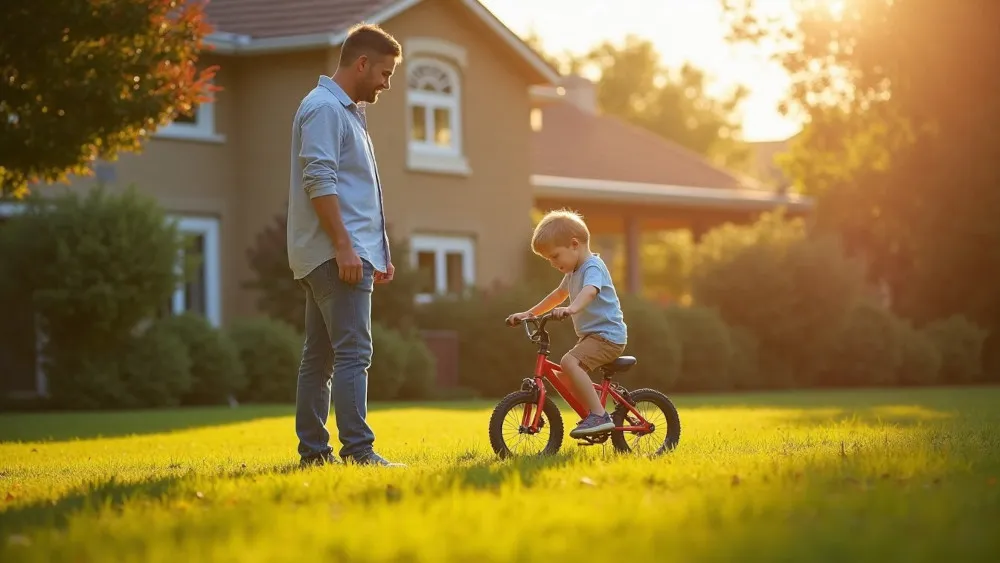
When Stepping Back Becomes Love
Letting children become more independent is one of the harder parts of fatherhood. There comes a point when doing everything for them stops being helpful, and love has to become something quieter: guidance, trust, patience, and the courage to let them try.
You feel it before you fully understand it.
Moments when they hesitate but do not look back. Moments when they try to solve something on their own. Moments when your instinct is to step in, but something deeper tells you to wait.
Letting them try is harder than it sounds.
Because stepping back can feel like risk.
It can feel like losing control.
Like leaving too much room for mistakes.
Like trusting something you cannot fully measure yet.
But fatherhood keeps teaching me that love does not only guide children while they are close.
Sometimes love prepares them for the moments when I will not be standing close enough to catch every stumble.
That lesson connects naturally to How Fatherhood Changes You, because fatherhood does not only reshape responsibility. It also teaches you that your children are not yours to control. They are lives entrusted to your care while they become who they are meant to be.
Trust Is a Risk
Trusting your children means accepting uncertainty.
It means believing that the lessons stuck even when you are not there to reinforce them. It means allowing room for mistakes, knowing those mistakes are part of learning and not automatic signs of failure.
I have spent years guiding, correcting, protecting.
Now, slowly, fatherhood is asking something different of me.
To loosen my grip.
Not because I care less.
Because I am learning to trust more.
That is difficult for a father who wants to protect. It is difficult to watch a child struggle through something you could solve quickly. It is difficult to let them experience frustration when your instinct is to remove it.
But if I remove every obstacle, I may also remove the confidence they were meant to build.
If I answer every question before they wrestle with it, I may teach them to doubt their own ability.
If I step in every time they hesitate, I may accidentally teach them that hesitation means they cannot handle what comes next.
That is not what I want.
I want them to know I am near.
But I also want them to know they are capable.
Self-Reliance Without Abandonment
I want my children to be capable.
Confident.
Able to stand on their own.
But I never want them to feel alone in that process.
Self-reliance, when done well, is not isolation. It is assurance. It is knowing you can handle things while still knowing support exists if you need it.
That balance matters deeply to me.
Because I know what self-reliance can become when it is shaped by survival instead of safety.
I know what it feels like to learn independence too early. To figure things out alone because no one was close enough, steady enough, or safe enough to help.
That is not the kind of independence I want to pass down.
I want my children to learn strength without loneliness. Confidence without emotional distance. Capability without believing they have to carry everything alone.
So I try to step back without disappearing.
To give space without withdrawing.
To trust without disconnecting.
That is why this chapter belongs close to What Children Learn From Their Father Without Being Taught, because children do not only learn independence from what I say. They learn it from how I model support, trust, humility, and the ability to ask for help.
Mistakes Are Part of Learning
One of the hardest things to accept is that mistakes are not always emergencies.
Sometimes they are teachers.
That does not mean I ignore danger, disrespect, or choices that require correction. It means I am learning to distinguish between a moment that needs protection and a moment that needs practice.
There are mistakes that require guidance.
There are mistakes that require consequences.
And there are mistakes that simply require experience.
That distinction is not always easy.
My instinct wants to prevent pain. To keep the path smooth. To make sure they do not have to learn things the hard way if I can help it.
But some lessons only become real when they are lived.
A child who never gets to try may never learn what effort feels like. A child who never gets to struggle may never learn persistence. A child who never gets to recover from small mistakes may fear failure more than necessary later.
So I am learning to let some moments unfold.
Not carelessly.
Not passively.
But with enough trust to let growth happen.
That connects naturally to How to Discipline Your Children Without Breaking Trust, because correction is not only about stopping behavior. Sometimes it is about guiding the learning process without making mistakes feel like rejection.
Family Dynamics Shift as They Grow
The dynamics in a family are not fixed.
They evolve.
What once required constant guidance begins to require observation instead. What once needed correction begins to need encouragement. What once demanded close supervision begins to ask for room.
I am learning to notice those shifts instead of resisting them.
That takes humility.
Because fatherhood changes shape as children grow. A father who refuses to adjust may keep giving yesterday’s guidance to a child who is ready for tomorrow’s responsibility.
There are seasons where children need hands-on help.
There are seasons where they need reminders.
There are seasons where they need room to test what has already been taught.
And every shift asks something from me.
More trust.
More patience.
More listening.
More willingness to let growth look imperfect.
That patience connects naturally to How Fatherhood Teaches Patience Through Everyday Moments, because letting children grow often requires me to slow down, wait, and trust the process instead of rushing to control it.
Fatherhood does not end when children grow.
It changes shape.
And each change asks for a new kind of love.
A Quiet Blessing
“The righteous lead blameless lives; blessed are their children after them.”
That verse does not promise perfect outcomes.
It points to influence.
It reminds me that faithfulness today echoes forward, even when I cannot see how it lands.
That comforts me.
Because fatherhood is full of moments where I do not know whether the lesson took root. I do not always know if my words landed. I do not always know if my example was clear. I do not always know if what I planted will hold when they are standing in a moment without me.
But I can keep planting.
I can keep modeling.
I can keep showing up with integrity, patience, repair, faith, and love.
And then, slowly, I can learn to trust the harvest to God.
Trusting the Work That Has Been Done
Letting them try does not mean I have stopped caring.
It means I have started believing.
Believing that love has taken root.
Believing that guidance has shaped something real.
Believing that mistakes can become teachers.
Believing that I do not have to control every step for them to walk well.
This is not easy.
Some days, stepping back feels peaceful.
Other days, it feels like grief.
Because every new sign of independence reminds me that they are growing. That they will not always need me in the same way. That part of loving them well is preparing them for a life I cannot fully manage for them.
But that is the point.
Fatherhood is not only about teaching.
It is about trusting what has already been taught.
And learning to smile quietly when they take the next step on their own.
What This Chapter Taught Me
Letting children become more independent is not the same as withdrawing from them.
Stepping back can be an act of trust, not distance.
Self-reliance is healthiest when children know support still exists.
Mistakes can teach confidence when they are met with guidance instead of fear.
I am learning that fatherhood is not only about protecting my children from every hard moment.
It is about helping them become strong enough to face life with wisdom, support, faith, and courage.
Love teaches.
Then love trusts.
And sometimes the quietest sign that something has taken root is watching them try without needing me to hold every step.
Continue the Story
- What Children Learn From Their Father Without Being Taught
How habits, reactions, support, and ordinary moments quietly become legacy. - How to Discipline Your Children Without Breaking Trust
How correction can guide children without making mistakes feel like rejection. - How Ordinary Days Shape Family Life as a Father
How ordinary routines, repeated effort, and quiet consistency shape family life over time.
Move Through This Book