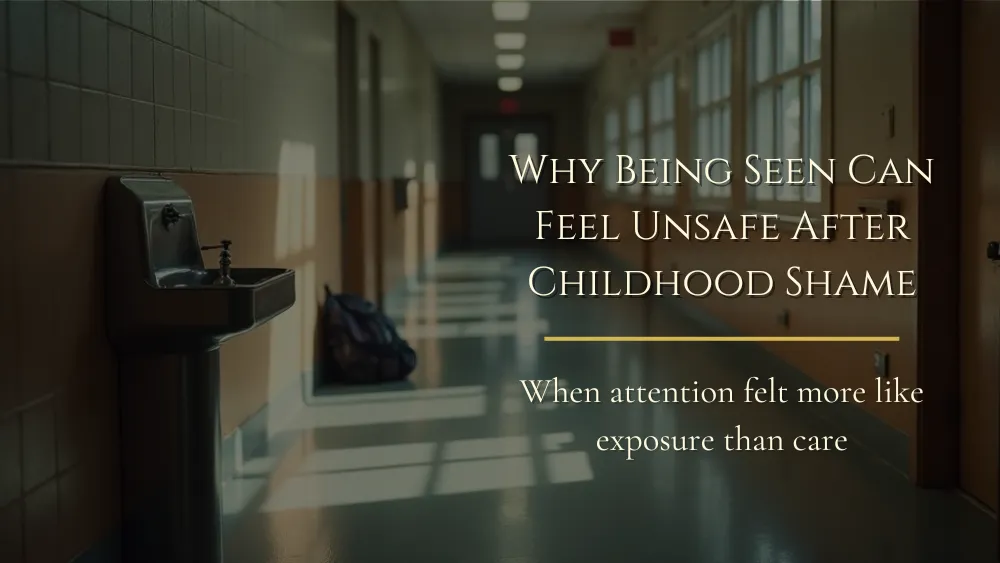
Why Being Seen Can Feel Unsafe After Childhood Shame
Being seen can feel unsafe when childhood taught you that attention led to embarrassment, punishment, or shame. Sometimes hiding is not just shyness. Sometimes it is a survival pattern built by moments when being noticed did not bring care, but exposure.
This chapter is for anyone who learned to disappear when something went wrong, explain quickly when misunderstood, hide problems until they became bigger, or fear that being noticed would lead to judgment instead of help.
When Attention Felt Like Exposure
I do not think I was born wanting to hide.
I think I learned it.
There is a difference.
Some children are quiet because that is their personality. Some children are quiet because they are watching the room, reading faces, trying not to become the reason attention turns sharp.
For me, being noticed did not always feel safe.
It could mean embarrassment.
It could mean correction.
It could mean punishment.
It could mean someone discovering something I was already ashamed of.
That kind of attention teaches a child to become careful.
Careful with needs.
Careful with mistakes.
Careful with emotions.
Careful with anything that could make people look too closely.
This is part of the larger Beginnings story, because the way a child learns to experience attention can shape identity long before adulthood gives language to it. It connects closely to How Childhood Trauma Shapes Who You Become (Where My Story Begins), because being seen, unseen, ignored, punished, or misunderstood can quietly shape the adult you become.
For a long time, I did not understand that.
I just thought I was private.
But some privacy is not privacy.
Sometimes it is protection.
The Day I Tried to Hide What Happened
When I was a child, I struggled with bladder control.
That is not an easy thing to say.
Even now, writing it feels vulnerable because childhood embarrassment has a way of staying alive long after the moment has passed. It is one thing to remember pain. It is another thing to remember shame.
One day in fifth grade, I had an accident at school.
I knew what had happened, and I knew what it would mean if other kids noticed. So I tried to fix the story before anyone else could define it for me.
I went to the water fountain and splashed water on myself.
In my mind, maybe it could look like I had just made a mess at the fountain. Maybe I could explain it away. Maybe I could escape the humiliation before it had a name.
But it did not work.
The other kids knew.
And once they knew, I felt exposed.
Not just embarrassed.
Exposed.
There is a certain kind of childhood shame that makes you feel trapped inside your own body. You cannot disappear. You cannot undo what happened. You cannot make everyone forget. You just have to stand there while something you could not fully control becomes something people can laugh at.
I did not feel safe with my classmates.
But what hurt more is that I did not feel safe bringing that pain home either.
When Home Did Not Feel Like a Safe Place to Be Embarrassed
When I got home, I immediately took a shower.
That was unusual for me. I did not normally take a shower without being told. But I wanted to wash the day off of me.
The accident.
The embarrassment.
The feeling of being seen in the worst possible way.
When my dad got home, I was getting out of the shower. I remember saying something like, “That shower felt good.”
But he knew something was not right.
And instead of that moment becoming a doorway into care, it became another place where shame met punishment.
I was punished.
I had to sit on my bed until dinner time.
That may sound small from the outside. But to a child, it taught something much bigger.
It taught me that even things hard to control could still cost me.
It taught me that embarrassment was not something I could safely bring to an adult.
It taught me that being discovered was dangerous.
It taught me that if something was wrong, I should hide it better next time.
That is the part that stays.
Not just the punishment.
The lesson underneath it.
When a child is punished for what already made him feel ashamed, he may learn to hide pain instead of asking for help.
That was one of those moments.
A child needed compassion, privacy, and reassurance.
Instead, I learned seclusion.
Learning to Stay Unnoticed
After enough moments like that, staying unnoticed begins to feel wise.
You learn to manage perception before people can misunderstand you.
You learn to explain quickly when something is not what it looks like.
You learn to hide embarrassment before someone else can use it against you.
You learn that problems are safer when they stay private, even if keeping them private makes them worse.
That is one of the ways childhood shame becomes identity.
It does not always announce itself as trauma. Sometimes it looks like personality.
I am just private.
I do not like needing help.
I handle things myself.
I do not want people in my business.
I would rather be alone.
But underneath those statements, there may be a younger part of you still trying to avoid being exposed.
That pattern belongs near Why Being Seen Can Feel Unsafe After Childhood Trauma, because hiding is not always about wanting isolation. Sometimes hiding is about remembering that attention once came with a cost.
For me, it became easier to remove myself from everyone when embarrassment showed up.
If something felt humiliating, I wanted distance.
If something was misunderstood, I wanted to explain fast enough to stop shame from attaching to it.
If I needed help, I felt shame for needing it.
And if a problem was personal, I often kept it hidden until it became bigger than it needed to be.
That is not because hiding helps.
It is because hiding once felt safer than being seen.
The Difference Between Positive and Negative Attention
The complicated part is this:
I do like attention.
I just do not like negative attention.
That matters because this chapter is not about wanting to disappear from life completely. It is about the ache of wanting to be seen in a safe way while fearing what happens when attention turns painful.
I think that reflects much of my childhood.
I did not receive much healthy attention.
Not the kind that says:
-
I see you.
-
I am proud of you.
-
You are safe with me.
-
You can tell me what happened.
-
You do not have to be ashamed.
So now, positive attention matters to me.
I want to be noticed for good things.
For effort.
For kindness.
For growth.
For the work I am trying to build.
For the person I am still becoming.
But negative attention feels different.
Negative attention feels like danger.
It feels like rejection waiting to happen.
It feels like people seeing something wrong with me and deciding that one exposed part is the whole story.
That is where this wound connects to How Childhood Emotional Neglect Teaches You to Survive. When a child does not receive enough safe attention, the need to be seen does not disappear. It may grow stronger. But so does the fear of being seen in the wrong way.
So I can crave attention and fear it at the same time.
I can want to be known and still want to hide.
I can enjoy being around people who feel non-judgmental, while feeling safer alone around people who might criticize, mock, misunderstand, or reject me.
That tension is hard to explain unless you have lived it.
How Shame Follows You Into Adulthood
Childhood shame does not always stay in childhood.
It grows up with you.
It changes clothes.
It shows up in adult situations that seem unrelated on the surface.
For me, it can show up when I feel embarrassed. I tend to hide. I pull away from people. I remove myself from the room, the conversation, or the situation.
It can show up when I feel misunderstood. I explain myself quickly, not always because the explanation is necessary, but because I am trying to stop embarrassment before it becomes permanent.
It can show up when I need help. I feel shame asking, even when help would make sense.
I am usually helping everyone else. I know how to give. I know how to show up. I know how to carry weight for other people.
But asking someone else to carry something with me feels harder.
Part of that is care for others.
But part of it is fear.
Fear of judgment.
Fear of being seen as weak.
Fear of needing too much.
Fear of becoming a burden.
Fear that if people see the need, they will reject the person.
That fear did not begin in adulthood.
It has roots.
It connects to How Childhood Trauma Affects You as an Adult, because the adult reaction often makes more sense when you understand the childhood moment that taught your body what attention could cost.
The child who sat alone after being embarrassed may become the adult who handles problems alone before anyone can see them.
The child who felt punished for something hard to control may become the adult who feels shame for needing help.
The child who was laughed at may become the adult who avoids any situation where rejection feels possible.
Why Rejection Feels So Dangerous
I think fear of rejection may be one of the biggest ways this still affects me.
If I feel like rejection is possible, I often avoid the situation entirely.
That can affect relationships.
It can affect dating.
It can affect asking for what I want.
It can affect being vulnerable before I know whether someone will handle that vulnerability gently.
It is probably one reason finding a girlfriend has felt so difficult. Not because I do not want connection. I do. Deeply.
But when rejection feels possible, avoidance can feel safer than trying.
The mind tells you it is protecting you.
Do not ask.
Do not risk it.
Do not let them see how much you care.
Do not put yourself in a position where they can say no.
Do not give someone the power to make you feel small again.
But avoidance has a cost too.
It protects you from possible rejection while also keeping you away from possible connection.
That is the painful trade.
The same pattern that kept a child safe can keep an adult lonely.
Sometimes the wall that protects you from shame also blocks you from being loved.
I am still learning how to tell the difference between real danger and old fear.
Being Seen Online
One of the clearest places this shows up now is with being on camera.
I have not wanted to talk on camera because I judge my own voice. I hear things I do not like. I notice speech issues. I imagine criticism before it happens.
In my mind, being on camera feels like giving people access to judge something personal.
My voice.
My face.
My words.
My pauses.
My imperfections.
That old fear says, “Do not let them see too much.”
But then something happened.
My Facebook analytics showed more than 10,000 views in a month.
And there were no negative comments.
That matters.
Because sometimes evidence gently confronts fear.
I had been judging myself more harshly than other people were judging me.
I had imagined rejection before it arrived.
I had expected criticism that never came.
That does not mean every person will always respond kindly. It does not mean being visible is risk-free. But it does remind me that my childhood expectations are not always accurate predictions of the present.
Sometimes the room is safer than my nervous system believes.
Sometimes people are not looking for the flaw I already found in myself.
Sometimes being seen does not lead to humiliation.
Sometimes being seen opens a door.
Learning That Being Seen Can Be Safe
I am trying to learn that people may not judge me the way I think they will.
That sounds simple.
It is not.
Because childhood shame does not heal just because the adult understands it logically. The body may still brace. The mind may still prepare explanations. The heart may still wonder whether rejection is coming.
Healing, for me, looks like slowing that process down.
It looks like noticing the fear without obeying it immediately.
It looks like asking:
Is this danger, or is this memory?
Is this person unsafe, or am I expecting them to be?
Am I hiding because I need privacy, or because shame is leading me?
Do I need to explain myself, or can I let the misunderstanding pass?
Can I ask for help without treating my need like a failure?
I do not think healing means I will suddenly love every kind of attention.
Some attention is unhealthy. Some rooms are unsafe. Some people do judge, mock, or misunderstand.
But not everyone.
That is the part I am learning.
Not every person is a classroom full of children laughing.
Not every adult is a parent ready to punish.
Not every mistake becomes a sentence.
Not every exposed place becomes shame.
Some people are safe.
Some attention is kind.
Some visibility is healing.
A Scripture I Am Carrying
There is a moment in Genesis where Hagar names God as the One who sees her.
That matters to me because being seen by people has not always felt safe.
But being seen by God is different.
God does not see to shame.
He sees to know.
He sees to care.
He sees what happened, what it cost, and what it formed inside us.
“You are the God who sees me.”
— Genesis 16:13
That verse does not erase the embarrassment of childhood.
It does not rewrite the moment at school.
It does not undo the punishment at home.
But it gives me a different kind of visibility to practice trusting.
A visibility that does not mock.
A visibility that does not punish a child for pain.
A visibility that says the parts of me I learned to hide are not hidden from God, and they are not too shameful for Him to hold.
What This Chapter Is Teaching Me
This chapter is teaching me that hiding was not random.
It was learned.
It is teaching me that embarrassment can become a doorway into isolation when no one meets it with care.
It is teaching me that needing help should not feel shameful, even if childhood made it feel that way.
It is teaching me that being noticed does not always mean being judged.
And it is teaching me that the child who wanted to disappear after being embarrassed deserved comfort, not punishment.
I am still learning how to be seen safely.
I am still learning how to ask for help without apologizing for needing it.
I am still learning how to let positive attention in without assuming negative attention is waiting behind it.
I am still learning that rejection is possible, but it is not guaranteed.
And maybe most importantly, I am learning that one painful memory does not have to define every room I enter now.
I was embarrassed.
I hid.
I learned.
I carried it.
But I am also allowed to heal.
Being seen once felt unsafe.
Now I am learning that being seen can also mean being known, accepted, and gently brought out of hiding.
Continue the Story
-
How Childhood Trauma Shapes Who You Become (Where My Story Begins)
How early pain shaped identity, reactions, relationships, and the way survival became part of the adult story. -
Why Being Seen Can Feel Unsafe After Childhood Trauma
How invisibility became a form of safety when attention felt dangerous. -
How Childhood Trauma Affects You as an Adult
How childhood survival patterns follow you into adult reactions, relationships, shame, and healing.
Move Through This Book